Recognizing When Job Strain Requires Professional Intervention

Therapy for workplace stress breaks chronic tension by teaching cognitive-behavioral tools that reframe unhelpful thoughts, building firm boundary-setting skills, and regulating the nervous system so daily demands no longer trigger a constant fight-or-flight response. Occasional deadlines and busy weeks are normal parts of working life. However, when pressure becomes unyielding, acute stress often evolves into chronic strain. You might find yourself feeling chronically depleted before your workday even starts. Over time, persistent job demands drain physical and psychological reserves, leading to vital exhaustion—a state characterized by profound energy loss, irritability, and demoralization.
When job demands continuously outstrip your available coping resources, emotional fatigue sets in. You might notice heightened stress reactivity, where minor issues—like an ambiguous email or a calendar reminder—trigger an intense fight-or-flight response. Left unaddressed, this ongoing strain leads to measurable productivity loss, cognitive brain fog, and severe occupational impairment. Recognizing these early signals allows you to intervene before temporary fatigue hardens into long-term burnout.
Evaluating When to Seek Therapy for Workplace Stress
Many professionals struggle to determine where healthy ambition ends and clinical distress begins. You do not need to experience a total professional breakdown to seek support. A valuable guideline is examining how pervasive your symptoms have become.
Consider seeking professional support if you notice:
- Persistent Dread and Anticipatory Anxiety: A constant knot in your stomach on Sunday evenings, or intrusive panic thoughts regarding routine daily tasks.
- Coping Mechanism Breakdown: Relying on unhealthy habits—such as increased alcohol consumption, emotional eating, or chronic doomscrolling—to numb the pressure of the workday.
- Work-Life Spillover: Snapping at family members, withdrawing from friendships, or feeling unable to be emotionally present outside of your shift.
- Deteriorating Executive Function: Struggling to make basic decisions, prioritize tasks, or concentrate on complex projects.
Engaging in targeted individual therapy can provide an objective, structured environment to deconstruct these pressures, identify specific stressors, and restore emotional equilibrium.
Physical, Emotional, and Behavioral Indicators of Burnout
Burnout is not merely working long hours; it is a systemic syndrome resulting from unmanaged workplace stress. Its symptoms span physical health, emotional regulation, and daily behavior:
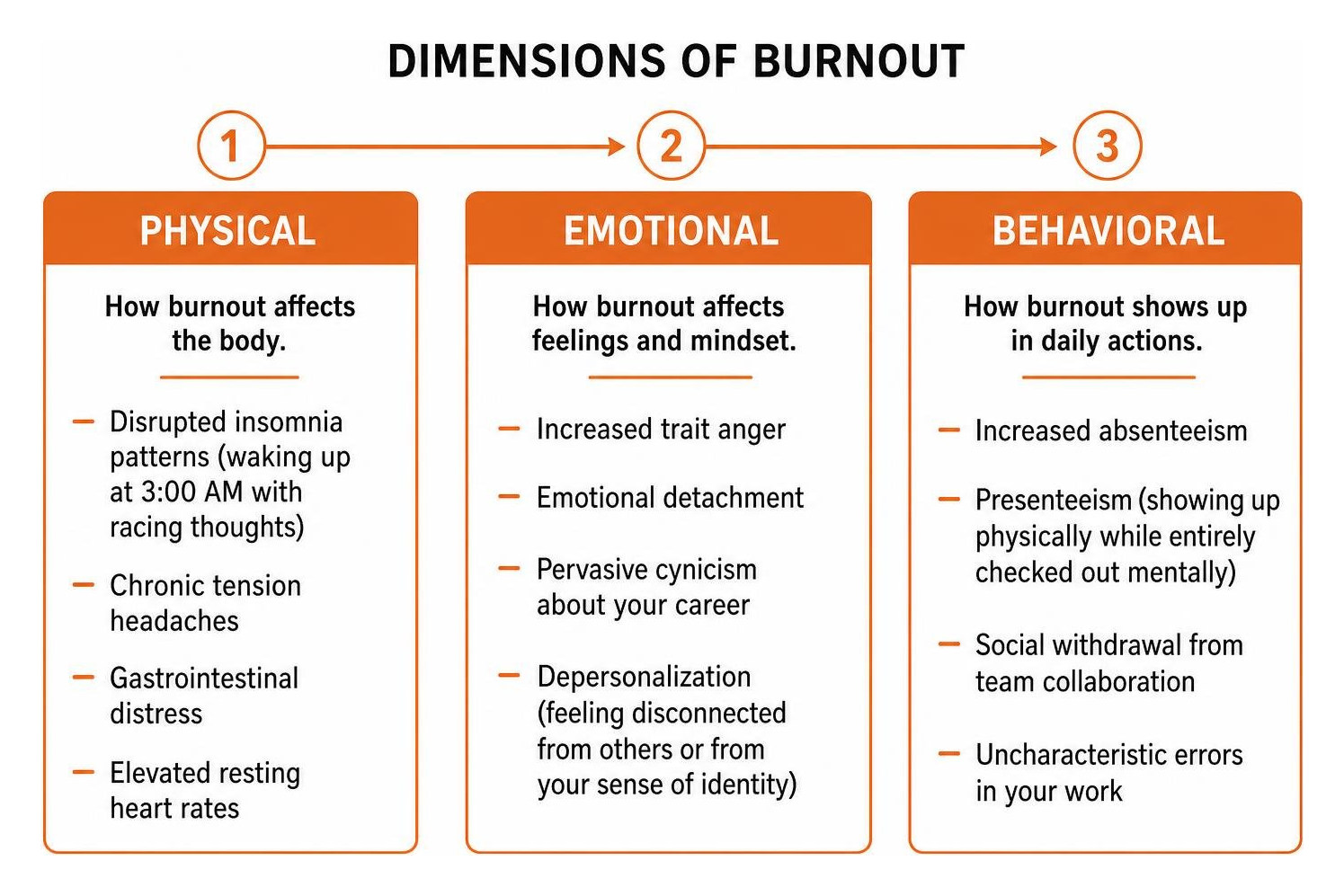
- Physical Manifestations: Disrupted insomnia patterns (such as waking up at 3:00 AM with racing thoughts), chronic tension headaches, gastrointestinal distress, and elevated resting heart rates.
- Emotional Responses: Increased trait anger, emotional detachment, pervasive cynicism about your career, and depersonalization (feeling disconnected from your clients, coworkers, or own sense of identity).
- Behavioral Shifts: Increased absenteeism, presenteeism (showing up physically while entirely checked out mentally), social withdrawal from team collaboration, and uncharacteristic errors in your work.
According to a comprehensive umbrella review of workplace mental health interventions, untreated occupational mental health challenges contribute heavily to the global disease burden. The review underscores that targeted psychological interventions yield significant, positive outcomes across symptom reduction and overall quality of life.
Evidence-Based Approaches in Therapy for Workplace Stress
Modern psychotherapy offers structured, evidence-based frameworks designed to unpack and alleviate occupational strain. Rather than offering generic advice, specialized clinicians utilize research-backed modalities to foster sustainable coping mechanisms and tangible symptom relief.

| Therapeutic Modality | Core Focus | Primary Mechanisms & Techniques | Best Suited For |
|---|---|---|---|
| Cognitive-Behavioral Stress Management (SMT) | Maladaptive thoughts & physiological reactivity | Cognitive restructuring, problem-solving mastery, relaxation training | Rumination, perfectionism, acute stress reactivity, panic |
| Work-Focused CBT (W-iCBT) | Occupational functioning & return-to-work pacing | Workplace exposure, task pacing, job demand-control analysis | Sickness absence, burnout, career stagnation, executive stress |
| Integrative / Multimodal Therapy | Holistic lifestyle, somatic symptoms & emotional processing | Somatic regulation, boundary negotiation, value realignment | Complex relational strain at work, chronic exhaustion, identity crises |
Cognitive-Behavioral Stress Management Training
One of the most robust frameworks for managing professional burnout is Cognitive-Behavioral Stress Management Training (SMT). This structured approach targets the connection between how we interpret occupational challenges and how our bodies react to them.
A landmark Frontiers study on cognitive-behavioral stress management training revealed that SMT produces statistically significant improvements in stress reactivity, vital exhaustion, and trait anger compared to control conditions. Specifically:
- Participants in the SMT group exhibited a large effect size of 1.40 for improvement in overall stress management skills (measured via the ISBF) from baseline to three-month follow-up.
- The intervention achieved a large effect size of 1.48 in reducing physiological and psychological stress reactivity (SRS total-score).
- Crucially, mediation analyses revealed that mastering changing cognitions (learning practical cognitive restructuring and systematic problem-solving) was the primary mechanism driving beneficial outcomes across nearly all psychological domains.
By learning to identify cognitive distortions—such as "catastrophizing" missed milestones or falling into "all-or-nothing" perfectionism—professionals can significantly reduce their baseline physiological arousal.
Digital, Work-Focused, and Multimodal Modalities
While traditional psychotherapy provides broad emotional support, recent clinical advances demonstrate the power of work-focused interventions. A prominent randomized controlled trial on work-focused internet interventions evaluated employees suffering from severe stress-related disorders. The study found that while both generic and work-focused cognitive-behavioral interventions produced large reductions in burnout (effect sizes of 1.00 and 0.83, respectively), the work-focused program offered unique occupational benefits.
Specifically, work-focused therapy led to marked improvements in overall work ability and reduced short-term sickness absence by 445 days compared to a waitlist control (and by 324 days compared to generic interventions). These tailored programs incorporate real-world occupational exposure, job demand-control mapping, structured boundary exercises, and phased return-to-work schedules. Combined with virtual delivery models, teletherapy provides busy professionals with flexible, outcome-tracked care without the added burden of commuting.
Practical Steps for Navigating Mental Health Care and Finding the Right Clinician
Taking the first step toward finding a therapist can feel daunting when you are already running on empty. However, breaking down the search into straightforward, practical steps makes the process manageable.

- Define Your Needs: Clarify whether you are managing general anxiety, acute workplace burnout, corporate conflict, or career transition stress.
- Evaluate Credentials: Look for licensed master's- or doctoral-level professionals (such as Licensed Professional Counselors, Licensed Clinical Social Workers, or Clinical Psychologists) who have verified experience in occupational stress and evidence-based modalities.
- Inquire About Modality and Flexibility: For demanding schedules, teletherapy removes commute friction while maintaining full HIPAA compliance and clinical efficacy.
- Schedule Consultations: Contact multiple providers for brief initial consultations to assess their communication style, therapeutic philosophy, and clinical rapport.
What to Expect in Your First Session of Therapy for Workplace Stress
Your initial session is primarily an assessment and foundation-building meeting. You do not need to arrive with every solution in mind; your clinician is there to guide the dialogue.
During this intake, your therapist will review standard confidentiality policies—ensuring you understand that what you share regarding your workplace, colleagues, or employer remains strictly private. They will gather background information on your professional role, family history, and primary stress triggers. A key part of this stage involves aligning your individual therapy goals, moving from vague feelings of being overwhelmed to specific milestones like establishing boundaries with off-hours emails, reducing panic symptoms before meetings, and rebuilding personal time.
Overcoming Financial Barriers and Assessing Provider Quality
Navigating therapy costs requires a clear view of your available options. If your employer does not provide comprehensive in-network mental health coverage, ask providers if they offer sliding-scale fees based on income or if they can furnish "superbills"—detailed itemized receipts you can submit to your insurer for out-of-network reimbursement. You can also utilize Health Savings Accounts (HSA) or Flexible Spending Accounts (FSA) to cover treatment with pre-tax dollars. Structured telehealth care packages can also offer transparent, predictable pricing models designed for consistent care.
Alongside cost, ensure you assess clinical quality. A competent, ethical therapist maintains clear professional boundaries, focuses on your stated goals, listens actively without dominating the conversation, and provides evidence-based techniques tailored to your workplace reality.
Supporting Colleagues and Cultivating Workplace Resilience
Workplace mental health is not solely an individual responsibility; it is heavily shaped by organizational culture, leadership empathy, and peer support systems. When employees look out for one another and managers actively foster psychological safety, teams experience less turnover and lower rates of chronic exhaustion.
Strategies for Coworkers, Managers, and Organizations
Creating a supportive, sustainable workplace involves actionable steps across all levels of an organization:
- Conduct Supportive Check-Ins: Instead of standard status updates, ask open-ended questions like, "How are you managing your workload this week?" or "What roadblocks can we clear together?"
- Promote Mental Health Literacy: Normalize discussions around mental health by sharing educational materials and clearly explaining how to access employee assistance programs or external therapy services.
- Model Clear Boundaries: Leaders should practice what they preach by avoiding late-night emails, taking scheduled time off, and respecting personal non-work hours.
- Implement Systemic Workload Adjustments: When an employee displays acute signs of burnout, collaborate on temporary task redistributions, flexible scheduling, or project realignments rather than expecting them to simply push through.
- Establish Psychological Safety: Ensure that discussing stress, asking for help, or flagging unrealistic deadlines is met with collaborative problem-solving rather than penalization or professional stigma.
Frequently Asked Questions About Occupational Mental Health Support
If you have additional questions about navigating therapy, review these answers and explore our frequently asked questions for more details.
How can I afford care if my employer does not provide mental health coverage?
If you lack employer-sponsored mental health benefits, you have several viable options:
- Out-of-Network Reimbursement: Request a monthly superbill from your therapist to submit to your health plan for partial out-of-network reimbursement.
- HSA/FSA Funds: Pay for individual therapy sessions using pre-tax funds from a Health Savings Account or Flexible Spending Account.
- Sliding-Scale Services: Many private practices and university training clinics reserve appointment slots for clients paying reduced rates adjusted for income.
- Telehealth Packages: Explore bundled virtual care plans that provide transparent, predictable session costs.
What red flags indicate an ineffective or unethical therapist?
A therapeutic relationship should feel safe, professional, and goal-directed. Watch for these warning signs:
- Excessive Self-Disclosure: The therapist spends substantial session time discussing their own personal or professional problems.
- Judgmental or Dismissive Behavior: Minimizing your workplace struggles, shaming your emotional responses, or demonstrating visible boredom.
- Boundary Violations: Attempting to form dual relationships outside of clinical care or violating confidentiality rules.
- Lack of Structure or Collaboration: Drifting aimlessly without treatment plans, tracking no progress, or refusing to adapt techniques to your work environment.
How does work-focused therapy differ from general counseling?
General counseling typically explores broad emotional themes, interpersonal dynamics, and historical family patterns. While these remain valuable, work-focused therapy directly targets occupational functioning. It involves analyzing specific job demands and control levels, identifying interpersonal conflict patterns at work, practicing communication skills for difficult managers, and structuring gradual exposure to workplace tasks to overcome avoidance and rebuild career self-efficacy.
Conclusion
Chronic workplace tension does not have to be the price of professional ambition. While you cannot always control corporate restructuring, demanding clients, or market pressures, you can change how your nervous system responds to those demands. Through evidence-based psychotherapy, you can unlearn automatic stress reactions, establish firm professional boundaries, and regain your personal life.
When you are ready to move from survival mode to sustainable career growth, schedule a confidential consultation with our team. We deliver evidence-based, outcome-tracked care through licensed master's- and doctoral-level clinicians via our specialized professional program, helping you break the cycle of chronic workplace strain and build lasting resilience.