Why Therapy Goals Matter and How to Choose Yours
How to Choose Individual Therapy Goals

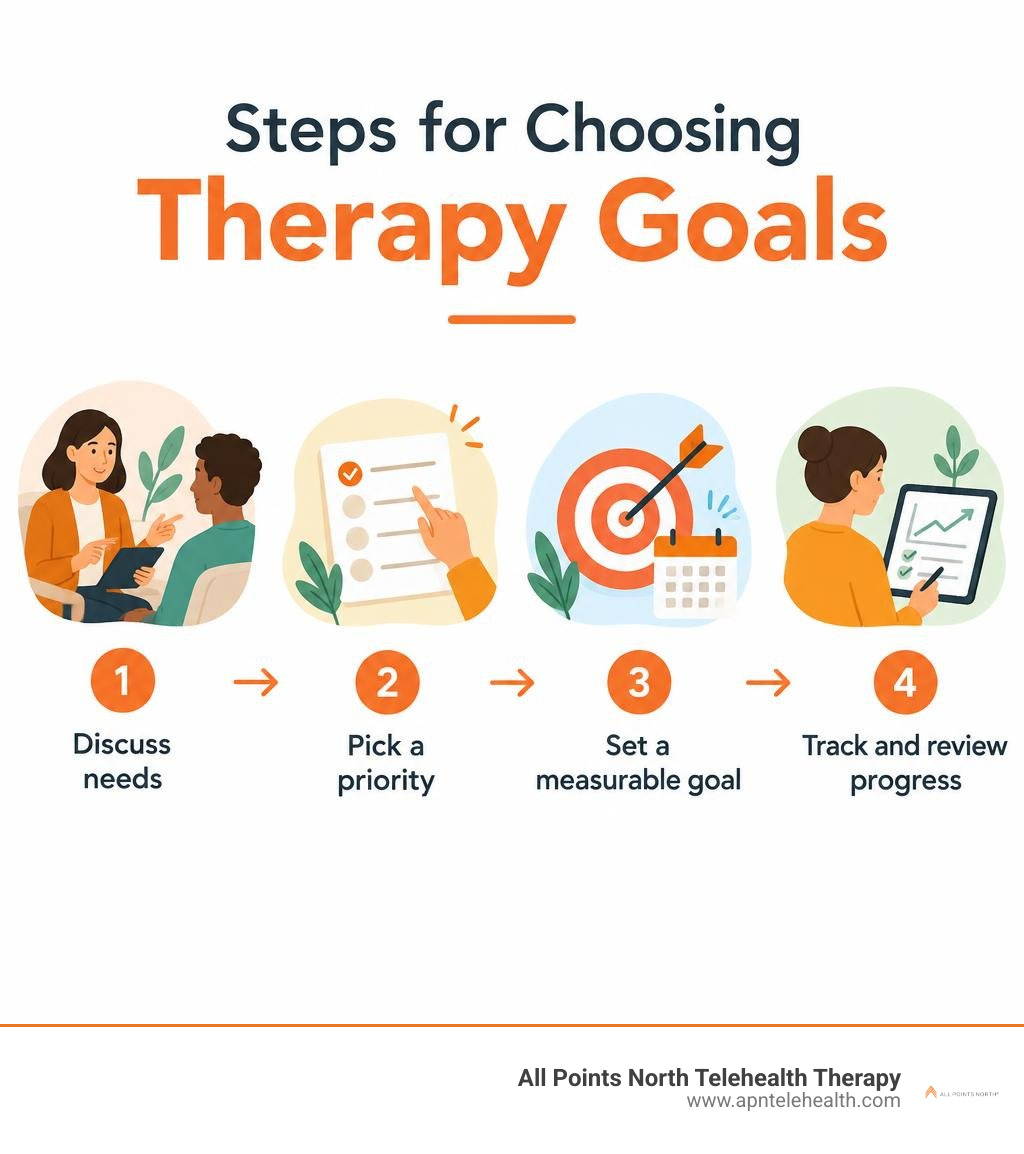
Start with one change that matters in your daily life. Tell your therapist what feels hard now and what you would like to do differently. Together, turn that wish into a goal you can track, such as getting through a work meeting without leaving early. Set a realistic time to check your progress, then adjust the goal if your needs change.
You do not need to arrive with a plan. If stress or burnout makes it hard to name a goal, your first step can be figuring out what matters most to you.
Setting Effective Individual Therapy Goals: The Clinical Value and Impact
When entering therapy, simply wanting to "feel better" is a natural starting point. However, translating that general desire into clear, individualized therapy goals forms the backbone of successful treatment. A strong therapeutic alliance is built on shared expectations, and establishing concrete targets ensures that both you and your clinician are moving in the same direction.
Research underscores that goal setting is not merely an administrative exercise. In a comprehensive study examining goal selection and progress, research on therapy goal selection and outcome gains demonstrated that the attainment of specific goal categories directly correlates with substantial improvements in clinical outcomes. When patients actively engage in identifying what they want to achieve, treatment engagement deepens, motivation rises, and therapeutic momentum builds.
Moreover, a meta-analysis on personalized treatment goals (Lindhiem et al., 2016) revealed that psychotherapy may be even more effective at helping people reach their personalized milestones than broad symptom checklists indicate. Focusing strictly on symptom scores can inadvertently overlook meaningful personal victories, such as reconnecting with an old friend or speaking up during a challenging team meeting.
Individual Therapy Goals vs. Standardized Symptom Measures
Standardized assessment tools, such as the Patient Health Questionnaire-9 (PHQ-9) for depression and the Generalized Anxiety Disorder-7 (GAD-7) scale for anxiety, offer valuable clinical data. On the PHQ-9, scores between 0 and 4 reflect minimal depression, and a drop of 5 points or more represents a clinically meaningful improvement. Similarly, the GAD-7 categorizes anxiety levels into mild (5–9), moderate (10–14), and severe (15–21), with scores of 10 or above indicating clinically significant symptoms.
While these rating scales provide essential benchmarks, they do not tell the whole story. A standardized measure captures the presence of symptoms, but individualized targets capture functional recovery—how you actually live your life.
| Feature | Standardized Symptom Measures (e.g., PHQ-9, GAD-7) | Personalized Therapy Goals (e.g., Goal Attainment Scaling) |
|---|---|---|
| Primary Purpose | Quantifies general symptom severity across a clinical population. | Identifies specific, meaningful behavioral changes in daily life. |
| Measurement Approach | Fixed question sets with numerical scales. | Highly tailored milestones reflecting personal values and routines. |
| Clinical Strength | Establishes medical necessity and tracks standardized improvement. | Boosts personal motivation and measures real-world functional gains. |
| Limitations | May miss qualitative, subjective progress in personal functioning. | Requires clinical skill to structure into measurable, trackable milestones. |
Integrating both approaches offers a complete clinical picture: standardized assessments track symptom reduction over time, while personalized benchmarks ensure treatment aligns with what matters most to you.
How Goal Attainment Drives Long-Term Treatment Success
Reaching therapeutic milestones reinforces self-efficacy—the confidence in your ability to manage life’s stressors. When you work with your therapist to dismantle avoidance patterns, practice cognitive restructuring, and engage in behavioral activation, achieving each target acts as evidence of your resilience.
This process transforms abstract insights into sustainable habits. Reducing acute symptoms brings immediate relief, but learning how to navigate triggers, establish healthy boundaries, and restore personal functioning produces long-term psychological wellbeing.
Structuring Clear Objectives with the SMART Framework
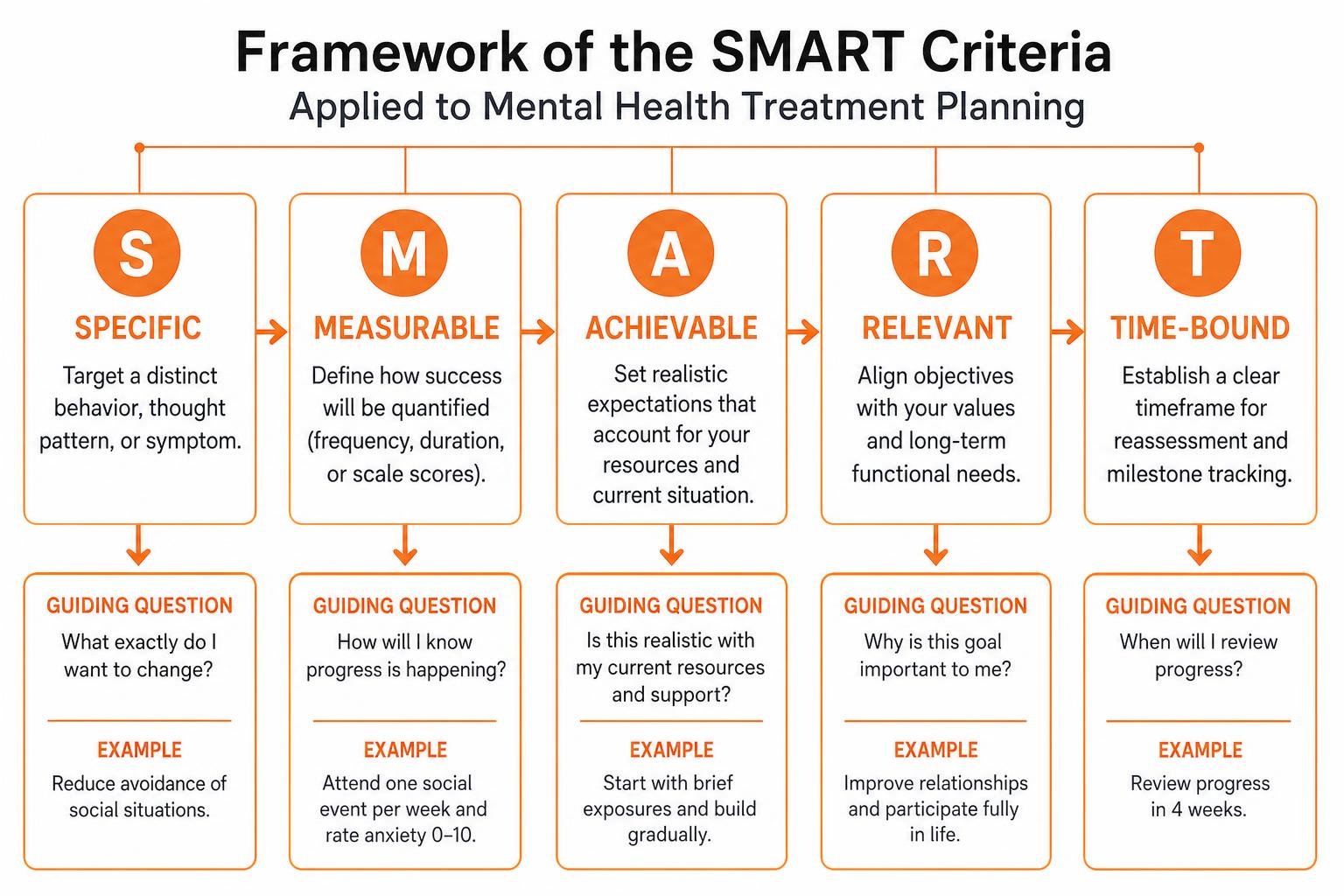
To turn aspirations into real-world progress, clinicians rely on the SMART framework. This model ensures that every objective is clearly defined, actionable, and trackable.

- Specific: Target a distinct behavior, thought pattern, or symptom rather than a broad emotional state.
- Measurable: Define how success will be quantified, whether through frequency, duration, or validated scale scores.
- Achievable: Set realistic expectations that account for your current resources, strengths, and environmental demands.
- Relevant: Align objectives directly with your core values and long-term functional needs.
- Time-Bound: Establish a clear timeframe for reassessment and milestone tracking.
Turning Vague Intentions into Measurable Progress
Broad statements often lead to stalled momentum because neither you nor your clinician has a concrete way to track progress. Applying the SMART framework bridges the gap between intention and action.
- Vague Intention: "I want to stop feeling so anxious all the time."
- SMART Objective: "Identify and practice diaphragmatic breathing or progressive muscle relaxation for 10 minutes daily when anxiety arises, reducing baseline GAD-7 scores by at least 5 points over the next 60 days."
- Vague Intention: "I need to get out of my depressive funk."
- SMART Objective: "Engage in behavioral activation by taking a 20-minute walk outdoors 4 mornings per week and logging daily mood, aiming for a 5-point reduction on the PHQ-9 within 90 days."
- Vague Intention: "I want to communicate better with my partner."
- SMART Objective: "Utilize 'I' statements and active listening techniques during weekly 15-minute relationship check-ins, tracking conflict resolution without verbal escalation over the next 6 weeks."
Factoring in Client Strengths and External Barriers
An effective plan is never built in a vacuum. It takes into account your personal strengths—such as creativity, problem-solving skills, or a dedicated support network—as foundational tools.
Equally important is identifying potential barriers early on. Psychosocial stressors, demanding work schedules, chronic physical health conditions, and cultural dynamics all influence how quickly or steadily you can progress. By anticipating these hurdles during intake, we tailor the pacing of your plan to ensure every milestone remains supportive and achievable.
Step-by-Step: How to Choose Meaningful Goals for Therapy
Choosing your focus in therapy is an evolving, collaborative process. Through motivational interviewing and guided discovery, you and your therapist will uncover the areas where change will make the greatest impact.

- Clarify Core Values: Pinpoint what truly matters to you—whether that is family connection, career fulfillment, personal autonomy, or emotional balance.
- Identify Primary Friction Points: Determine which symptoms or situations create the most significant disruption in your day-to-day life.
- Formulate Baseline Metrics: Assess current habits, avoidance behaviors, or symptom ratings (such as PHQ-9 or GAD-7 scores).
- Draft SMART Milestones: Structure realistic objectives using clear, quantifiable criteria.
- Establish Modality and Frequency: Select evidence-based approaches (such as CBT, ACT, or mindfulness techniques) and schedule consistent sessions. When designing a routine, exploring tailored telehealth care packages can help ensure consistent, structured support.
- Set Regular Review Checkpoints: Schedule periodic reviews every 30 to 90 days to celebrate progress and adjust targets as needed.
What to Do When You Are Unsure What to Work On
It is completely normal to arrive at your first session without knowing where to begin. You might feel overwhelmed, emotionally exhausted, or simply stuck in an indistinct fog.
In these moments, our clinicians use open-ended exploration to help you untangle what you are experiencing:
- Where do you notice the most friction in your daily routine?
- How is your sleep, energy level, or physical tension changing throughout the week?
- What activities or relationships have you found yourself avoiding recently?
- If a minor miracle happened tonight and resolved your main frustration, what would your morning look like tomorrow?
By exploring these questions together, broad feelings of stress naturally resolve into concrete starting points.
Practical Examples of Individual Therapy Goals by Diagnosis
Below are evidence-based examples of how broad clinical goals are translated into structured, measurable objectives across various mental health presentations:
Major Depressive Disorder
- Long-Term Goal: Reduce acute depressive symptoms and restore daily functional capacity.
- Objective 1: Complete a daily behavioral activation log, scheduling and completing at least one pleasurable or mastery-based activity 5 days per week for the next 6 weeks.
- Objective 2: Reduce PHQ-9 scores from a baseline of 16 (moderately severe) to below 10 (mild) within 90 days by practicing cognitive reframing of negative automatic thoughts.
Generalized Anxiety Disorder
- Long-Term Goal: Decrease chronic worry and eliminate avoidance behaviors in social and occupational settings.
- Objective 1: Maintain a daily worry log to identify cognitive distortions, applying 3 grounding techniques per week during episodes of heightened anxiety over the next 30 days.
- Objective 2: Attend two scheduled professional meetings per week without leaving early or engaging in safety behaviors, achieving a 5-point reduction on the GAD-7 within 60 days.
Adjustment Disorder
- Long-Term Goal: Develop adaptive coping strategies to navigate a recent life transition (e.g., divorce, job change, relocation).
- Objective 1: Identify and document 3 primary psychosocial triggers associated with the transition and formulate an actionable coping response for each within 30 days.
- Objective 2: Re-establish a stable daily routine—including consistent sleep and meal schedules—tracking adherence at least 5 days per week over the next 6 weeks.
Substance Use Disorder
- Long-Term Goal: Achieve and maintain substance reduction or abstinence while building healthy emotional coping skills.
- Objective 1: Identify top 5 internal and external substance-use triggers and create a written relapse prevention safety plan within the first 30 days of care.
- Objective 2: Attend weekly individual teletherapy sessions and engage in two recovery support meetings per week, maintaining self-reported abstinence over a 90-day review period.
Treatment Plan Reviews, Documentation, and Maintenance
A comprehensive treatment plan serves as an active clinical roadmap. Standards established by regulatory bodies like The Joint Commission require ongoing reassessment to ensure care reflects your evolving needs and treatment response. In outpatient settings, treatment plans are typically reviewed and updated every 30 to 90 days.
During these periodic reviews, clinicians document:
- Quantifiable Progress: Changes in standardized symptom measures (such as PHQ-9 or GAD-7) and direct tracking of behavioral milestones.
- Barriers Encountered: Life events, schedule shifts, or unexpected stressors that may have slowed progress.
- Plan Modifications: Discontinuing completed targets, updating timelines, or introducing new focus areas as initial symptoms resolve.
- Cohesive Alignment: Ensuring that weekly progress notes link directly back to the active treatment plan, establishing medical necessity and maintaining audit-ready documentation for insurance payers.
To explore more therapeutic strategies, clinical documentation best practices, and recovery resources, take a look at our mental health insights blog.
Frequently Asked Questions About Therapy Goals
How often should treatment plans and therapy goals be reviewed?
Review frequency depends on your level of care and specific clinical needs. In standard outpatient teletherapy, plans are typically updated every 60 to 90 days. In intensive outpatient programs (IOP) or when addressing acute crises, reviews occur every 30 days or immediately following any significant change in symptoms or risk status. You can find more details on our care structures in our frequently asked questions.
What happens if I do not reach my therapy goals within the planned timeframe?
Not meeting a goal within an estimated timeframe is not a failure—it is valuable clinical feedback. When a target is not met, you and your therapist will look at what got in the way. Was the objective set too aggressively? Did an unexpected life stressor arise? By recalibrating timelines, breaking large steps into smaller milestones, or adjusting interventions, the plan remains supportive rather than overwhelming.
Can a single treatment plan address both mental health and substance use goals?
Yes. Integrated treatment plans are the clinical gold standard for co-occurring mental health and substance use conditions (dual diagnosis). Addressing symptoms of anxiety or depression alongside substance use within a unified plan prevents fragmented care, allowing you to develop cohesive coping mechanisms that support both your mental well-being and recovery.
Moving Forward with Goal-Oriented Care
Setting clear, meaningful objectives transforms the counseling experience from vague conversations into a structured path toward lasting change. By grounding your treatment in evidence-based frameworks, tracking real-world milestones, and working collaboratively with an experienced clinician, you take an active, empowered role in your healing.
At All Points North Telehealth Therapy, our licensed, doctoral- and master’s-level clinicians provide HIPAA-compliant, outcome-tracked care tailored to your unique circumstances. Whether you are addressing anxiety, depression, trauma, or life transitions, we offer seamless coordination and clinical oversight every step of the way.
To take the first step toward reaching your personal mental health milestones, connect with us to begin individual therapy today.
Scientific References
Lindhiem O, Bennett CB, Orimoto TE, Kolko DJ. "A Meta-Analysis of Personalized Treatment Goals in Psychotherapy: A Preliminary Report and Call for More Studies.." Clinical psychology : a publication of the Division of Clinical Psychology of the American Psychological Association, 2016. PMCID PMC4912140.