How Family Therapy Helps Hoarding Families Move Forward

Start with safety, not a cleanout. Family therapy for hoarding families helps relatives agree on urgent needs, talk without blame, and set boundaries around shared spaces. A therapist can teach family members how to encourage treatment without taking control of the person's belongings. Look for a clinician experienced in hoarding-focused cognitive behavioral therapy (CBT), and ask whether relatives can begin getting support even if their loved one is not ready to attend.
Hoarding disorder can make rooms hard to use and leave everyone at home feeling stuck. Family support matters because change is often slow. The goal is to make the home safer while helping each person take a workable next step.
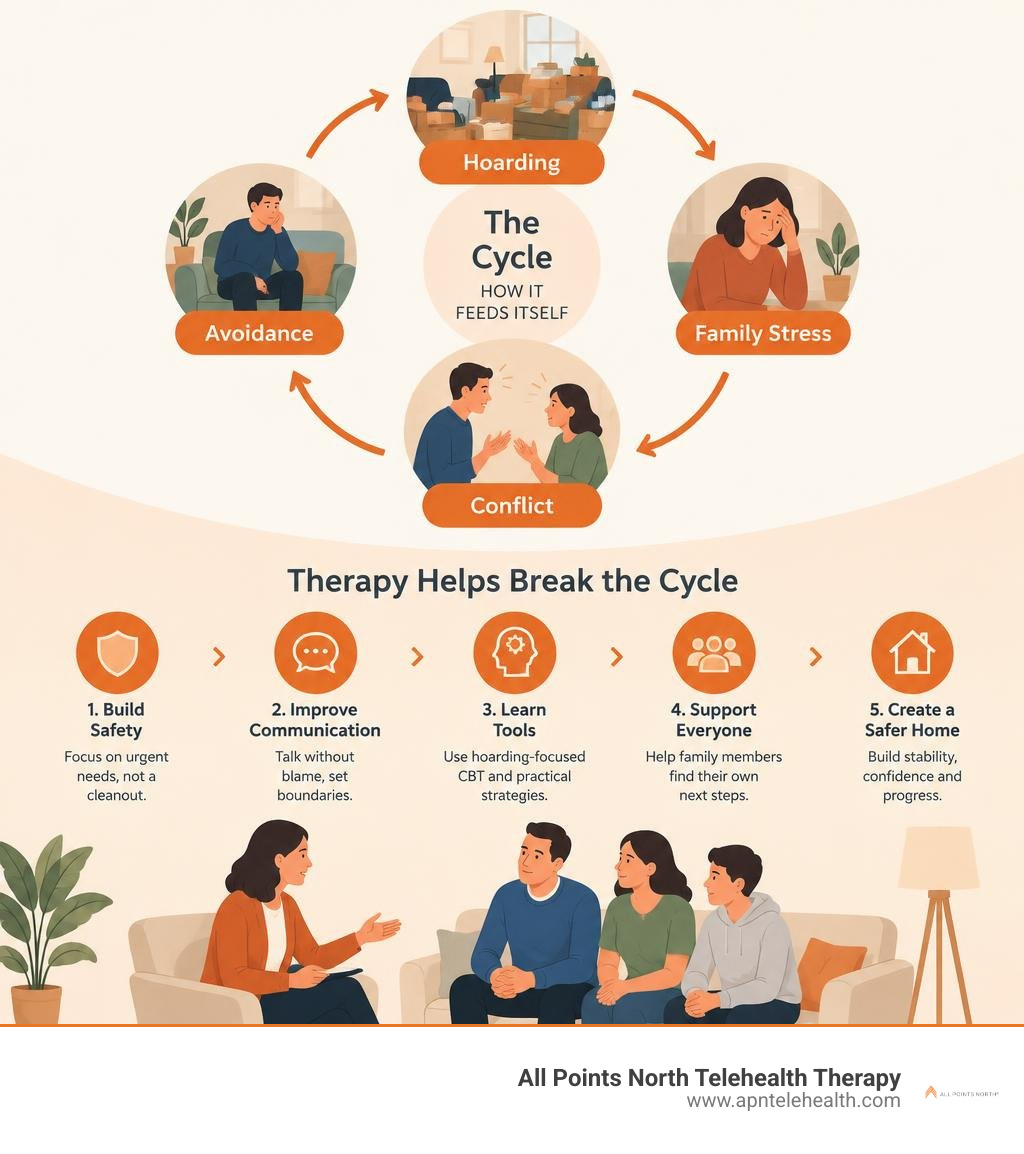
How Hoarding Disorder Impacts the Entire Family System
Hoarding disorder (HD) is officially recognized as a distinct clinical condition affecting approximately 2.6% of the population, with rates rising notably among adults over 60. While diagnostic manuals define hoarding by persistent difficulties discarding possessions and severe clutter that compromises living spaces (Frost & Gross, 1993), the reality inside the home is systemic. Hoarding rarely exists in a vacuum; it reverberates across every relationship under the roof.
Family members often experience severe emotional strain, prolonged distress, and social isolation. When living areas become unusable, simple daily activities—such as cooking a shared meal, sitting on a sofa, or taking a shower—transform into points of friction. Over time, family members report severe caregiver burden. In many homes, children experience "parentification," stepping up to manage household duties, pay bills, or navigate utility repairs because the hoarded environment prevents normal maintenance.
Moreover, families frequently face external stigma and what clinicians call "doorbell anxiety"—the paralyzing fear that a neighbor, landlord, emergency responder, or delivery driver might glimpse inside the home. A comprehensive survey on family burden and rejection attitudes revealed that family rejection attitudes toward individuals with hoarding are remarkably high (Tolin et al., 2008). In fact, rejection levels among relatives of individuals with hoarding disorder are higher than those found in families dealing with obsessive-compulsive disorder (OCD) and are comparable to families coping with severe psychotic conditions like schizophrenia.
Psychological Distress, Social Isolation, and Rejection in Loved Ones
Living with or caring for a loved one with severe hoarding generates deep psychological scars. Family members often battle chronic anxiety, internalized shame, and intense grief over the loss of a functional home life. Because fewer than 45% of individuals with hoarding disorder seek mental health treatment on their own—even though an estimated 84% acknowledge a significant problem—relatives are left carrying the emotional weight of an unmanaged crisis.
Recent qualitative research on the family experience emphasizes that family members frequently feel like the "forgotten clients" of mental healthcare. Relatives describe coping through emotional withdrawal, resentment, and profound loneliness because few outside the home understand the complexity of the disorder. When insight is low and clutter is high, interpersonal hostility often escalates, fracturing family bonds and leaving everyone feeling misunderstood and exhausted.
The Hidden Dangers of Family Accommodation
When family members do not know how to help, they often slip into accommodation behaviors. Family accommodation refers to changes that relatives make in their own routines or environments to reduce the affected individual's distress or avoid immediate conflict. While done out of love or sheer survival, accommodation paradoxically maintains and fuels hoarding behaviors over time.
Common accommodation patterns include:
- Renting off-site storage units to house overflow items, effectively funding the expansion of clutter.
- Taking over household responsibilities (cooking, laundry, cleaning) because functional spaces are blocked.
- Rearranging their own lives or giving up personal rooms to make space for accumulated items.
- Walking on eggshells and avoiding any discussion of safety or clutter to prevent anger and emotional blowups.
Core Modalities of Family Therapy for Hoarding Families
When families try to tackle hoarding on their own, well-meaning interventions often devolve into screaming matches or silent resentment. Specialized family therapy changes this dynamic by shifting the focus from the clutter itself to the relational patterns and emotional triggers driving the behavior.
In systemic and cognitive-behavioral family therapy, clinicians help relatives step out of the exhausting role of "clutter police" and transition into supportive allies. While a loved one may benefit from concurrent individual therapy to address underlying anxiety, grief, or decision-making deficits, family therapy creates a united front where boundaries are respected and mutual support replaces constant conflict.
| Family Accommodation (Enabling) | Healthy Boundary Setting (Therapeutic) |
|---|---|
| Paying for storage units to hold excess belongings | Refusing to subsidize or house off-site clutter |
| Stepping around blocked hallways and fire exits | Establishing non-negotiable safety clear zones |
| Secretly throwing away items when the person leaves | Maintaining transparent, collaborative discussions |
| Avoiding friends and family due to shame | Creating boundaries around guest access and social spaces |
| Taking over all chores to compensate for lost space | Setting clear agreements regarding shared living areas |
Psychoeducation, Motivational Interviewing, and the FAM Training Model
A cornerstone of modern family interventions is structured psychoeducation combined with communication skills training. One prominent evidence-based protocol is the Family-As-Motivators (FAM) training model. FAM training is designed specifically for relatives, equipping them with tools rooted in Motivational Interviewing (MI), harm reduction, and accommodation reduction.
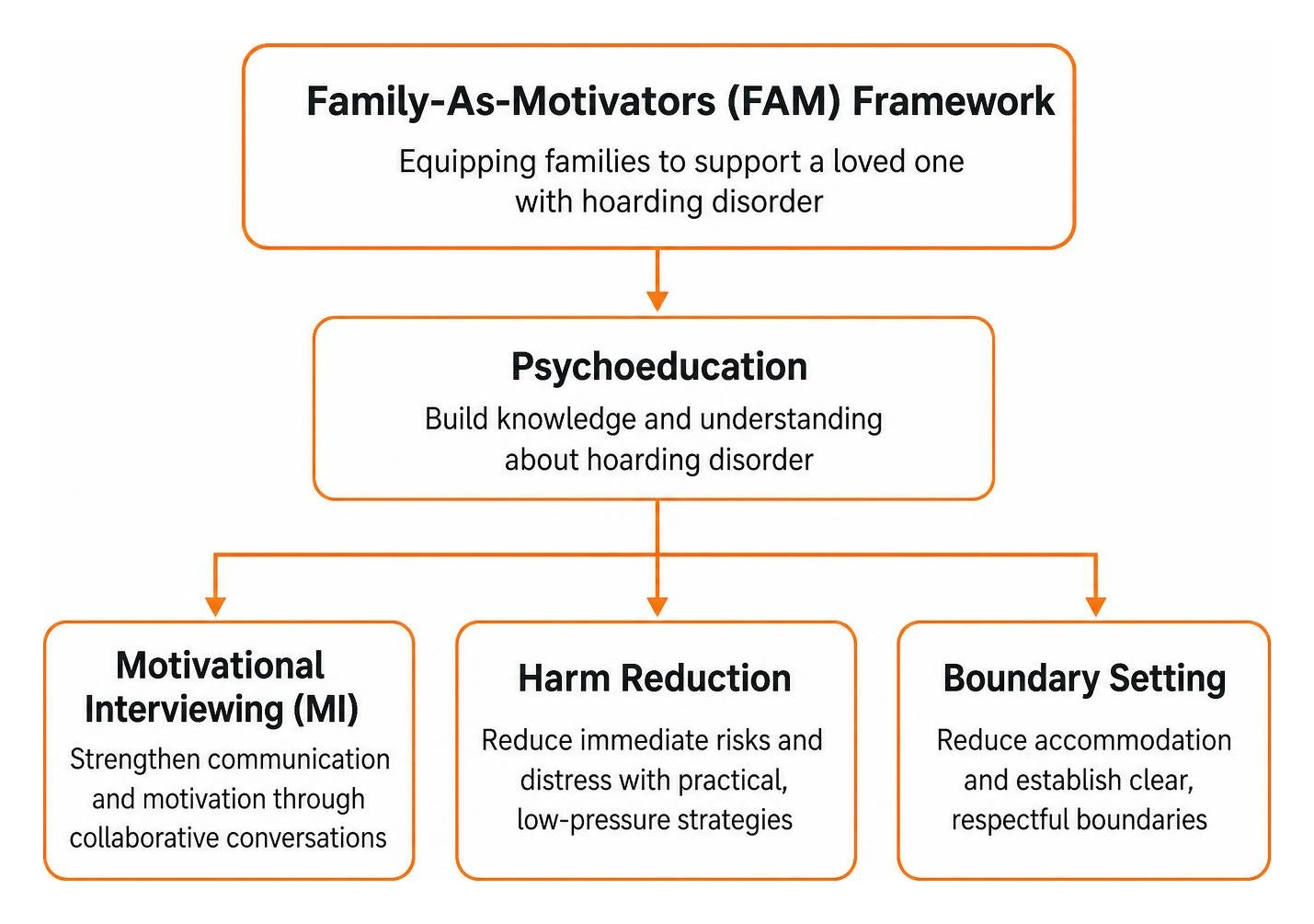
In the Family-As-Motivators pilot research, family members who completed the training demonstrated substantial improvements:
- Hoarding disorder knowledge jumped from 44% to 74% on objective assessments.
- Hopefulness and coping increased significantly, with notable decreases in self-blame, venting, and avoidant distraction.
- Positive reframing rose, allowing relatives to view hoarding as a treatable health condition rather than willful stubbornness or laziness.
- Family accommodation behaviors dropped markedly from pre- to post-intervention.
Through motivational interviewing, relatives learn to stop arguing and start using open-ended questions, reflective listening, and validation. Instead of saying, "You have to clean this mess up right now," family members learn to ask, "What are your main goals for using the kitchen safely this month?"
Practical Harm Reduction Strategies Versus Forced Cleanouts
One of the most dangerous instincts families have is executing a "surprise cleanout"—hiring a dumpster and clearing the home while their loved one is away. Research and clinical experience consistently show that forced cleanouts do not work. They trigger profound trauma, rupture family trust, and almost invariably result in rapid, aggressive re-hoarding within months.

Instead of demanding total decluttering overnight, family therapy employs harm reduction principles adapted from public health:
- Prioritizing Safety First: Ensuring clear, unblocked pathways (at least 31 inches wide) to all exterior exits.
- Eliminating Fire Hazards: Clearing a 3-foot perimeter around furnaces, heaters, stoves, and electrical panels.
- Restoring Basic Utilities: Making sure running water, refrigeration, functional toilets, and safe cooking surfaces are accessible.
- Mitigating Biohazards: Removing rotting food, pest infestations, and hazardous structural blockages first, without debating sentimental possessions.
Step-by-Step Guide to De-escalating Conflict and Fostering Change at Home
Restoring peace in a home impacted by hoarding requires structured communication protocols and disciplined boundary management. Here is how families can navigate daily challenges constructively:
Integrating Practical Communication Skills in Family Therapy for Hoarding Families
Therapy teaches families how to replace inflammatory confrontations with de-escalating dialogue:
- Use "I" Statements Instead of "You" Accusations: Trade "You are ruining our house" for "I feel overwhelmed and worried about fire safety when the hallway is blocked."
- Practice Empathetic Validation: Acknowledge the emotional difficulty of parting with possessions without validating unsafe environments. Say, "I understand these items feel deeply important to you, and I also want to make sure you have safe heat this winter."
- Focus on Function Over Aesthetics: Avoid commenting on the visual appearance of clutter. Instead, focus on utility: "Can we work together so you can comfortably reach your medicine cabinet?"
- Establish Calm Timeouts: Agree in advance that if discussions become heated, either party can call a 15-minute recess to regulate emotions before resuming.
Navigating Ambivalence and Readiness for Change
Ambivalence is the defining hallmark of hoarding disorder. Individuals often swing between acknowledging that the living conditions are unmanageable and fiercely defending their right to keep everything.
Family therapy helps relatives meet their loved one at their current stage of change:
- Pre-Contemplation: The individual sees no problem. The family focuses solely on harm reduction and non-negotiable personal safety boundaries.
- Contemplation: The individual acknowledges ambivalence ("I want my grandkids to visit, but sorting this out terrifies me"). Family members use reflective listening to amplify the person's own reasons for wanting change.
- Preparation & Action: The individual agrees to small experiments. The family celebrates incremental wins without pushing for total house clearance.
Building an Integrated Support Network and Treatment Plan
Sustainable recovery requires an integrated, coordinated strategy. A randomized trial on hoarding treatment outcomes evaluating group cognitive-behavioral programs (such as the Buried in Treasures workshop) paired with in-home coaching demonstrated large, clinically significant reductions in hoarding severity and functional impairment (Wheaton et al., 2024). Clinicians frequently utilize standardized visual tools, such as the Clutter Image Rating (CIR) scale, to help families objectively assess progress and maintain shared goals.
Choosing Specialized Clinical Care and Family Therapy for Hoarding Families
When seeking a therapist, families should look for licensed clinicians with specialized training in cognitive-behavioral therapy for hoarding disorder, family systems therapy, and motivational interviewing. It is essential to work with professionals who understand that hoarding is not simply severe disorganization, but a complex condition involving information-processing deficits, emotional attachment, and avoidance patterns.
Virtual Care and Between-Session Practice

Telehealth has revolutionized care for hoarding families. Because the home environment is central to the challenge, virtual therapy allows clinicians to observe living dynamics directly in real time, without the logistical stress of traveling to a clinic. Families can review customized telehealth care packages to receive structured, consistent support tailored to their unique scheduling and clinical needs.
Frequently Asked Questions About Family Support for Hoarding
For more general questions regarding our clinical approach and services, visit our frequently asked questions page.
What is the Family-As-Motivators (FAM) training model?
The FAM model is a specialized psychoeducational and skill-building framework designed for relatives of individuals with hoarding disorder. It trains family members in motivational interviewing, harm reduction strategies, and boundary setting to help reduce family distress and encourage their loved one to accept professional care.
How does family accommodation worsen hoarding behaviors?
Accommodation—such as renting external storage units, taking over neglected household chores, or avoiding safety conversations—shields the individual from the natural consequences of their clutter. This inadvertently reinforces avoidance and enables the condition to progress unchecked.
How can relatives encourage a loved one to seek help without causing conflict?
Focus on shared values, empathy, and objective safety rather than forced decluttering. Utilize motivational interviewing techniques: ask open questions about their personal goals, validate their emotional attachments, and propose consulting a therapist together solely to discuss home comfort and safety.
Conclusion
Hoarding disorder places immense pressure on the family unit, but families do not have to carry that burden alone or stay locked in exhausting cycles of conflict. With the right clinical guidance, clear boundaries, and evidence-based communication tools, lasting change and household safety are entirely achievable.
At All Points North Telehealth Therapy, our licensed clinicians provide compassionate, HIPAA-compliant virtual care designed to help families rebuild communication, establish healthy boundaries, and foster sustainable recovery. Explore our specialized family therapy programs today to take the first step toward reclaiming safety and harmony in your home.
Scientific References
Frost RO, Gross RC. "The hoarding of possessions.." Behaviour research and therapy, 1993. PMID 8512538. Tolin DF, Frost RO, Steketee G, Fitch KE. "Family burden of compulsive hoarding: results of an internet survey.." Behaviour research and therapy, 2008. PMCID PMC3018822. Wheaton MG, Varias AD, Sandhu T, Muñoz Rodríguez PA, Mukunda P, Filippou-Frye M, Millen A, Lombardi A, van Roessel P, Raila H, Anderson K, Linkovski O, Mahnke A, Sanchez C, McCarthy E, Wright B, Mibenge C, Rico Y, Righi S, Halsey C, Torio L, Asgari S, Qiu T, Garcia G, Jo B, Belofsky B, Shuer LJ, Frost RO, Rodriguez CI. "Randomized waitlist-controlled trial of buried in treasures facilitated support groups and in-home uncluttering (BIT+) for hoarding disorder.." Journal of psychiatric research, 2024. PMCID PMC12052455.