The Clinical Evidence for Individual Therapy for Bipolar Disorder

While mood stabilizers, second-generation antipsychotics, and adjunctive medications represent the neurochemical foundation of bipolar care, pharmaceutical intervention alone does not insulate against all environmental and psychosocial stressors. Clinical trials consistently illustrate that adjunctive psychosocial interventions dramatically alter the trajectory of the condition. According to landmark clinical trials and component network meta-analyses, combining pharmacotherapy with disorder-specific psychotherapy—such as CBT, IPSRT, or structured psychoeducation—is associated with an almost 50% reduction in 1-year rates of recurrence (OR = 0.56, 95% CI = 0.43–0.74) compared to pharmacotherapy plus treatment as usual (Yilmaz et al., 2025).
In the Systematic Treatment Enhancement Program for Bipolar Disorder (STEP-BD), participants randomly assigned to intensive psychotherapies (CBT, IPSRT, or Family-Focused Therapy) alongside pharmacological management demonstrated significantly higher rates of recovery, shorter intervals to recovery, and superior functional outcomes over one year compared to those receiving brief psychoeducation alone. Despite these proven outcomes, nationwide survey data show that only 50.4% of adults with bipolar disorder receive any form of psychotherapy alongside medication, and outpatient psychiatrists deliver psychotherapy in only 35.7% of visits.
Recent clinical research on psychosocial management emphasizes the necessity of targeted therapeutic mechanisms to sustain remissions.
| Modality | Primary Therapeutic Target | Mechanism for Mood Stabilization | Relapse Prevention Profile |
|---|---|---|---|
| Cognitive-Behavioral Therapy (CBT) | Cognitive distortions, maladaptive automatic thoughts, behavioral withdrawal | Cognitive restructuring, activity scheduling, thought records | Delays depressive recurrences; reduces medication noncompliance; optimal for earlier-stage illness. |
| Interpersonal & Social Rhythm Therapy (IPSRT) | Circadian dysregulation, interpersonal disputes, role transitions | Social Rhythm Metric (SRM), sleep-wake scheduling, grief work | Lengthens maintenance wellness; regulates biological zeitgebers; enhances vocational functioning. |
| Individual Psychoeducation | Illness literacy deficits, poor prodromal recognition | Early symptom signature mapping, medication side-effect management | Extends time to first manic recurrence; decreases hospitalizations; improves treatment adherence. |
Cognitive-Behavioral Therapy and Cognitive Restructuring
Cognitive-Behavioral Therapy tailored for bipolar disorder adapts standard cognitive restructuring to target the distinct phases of the illness. In depressive episodes, therapists assist individuals in dismantling depressive distortions, negative self-schemas, and catastrophic expectations. For manic and hypomanic states, CBT targets over-optimistic cognitions, racing thoughts, grandiosity, and impulsive goal-attainment drives that frequently precede acute escalation.
Trial data highlighted in systematic reviews of bipolar psychotherapies indicate that individual CBT significantly reduces rates of discontinuing mood stabilizers against medical advice, lowers hospital admissions, and yields fewer mood fluctuations over 12 to 30 months. Notably, clinical trials indicate an episode threshold: CBT demonstrates significant efficacy in delaying recurrences for individuals with fewer than 12 previous affective episodes, whereas individuals with a history exceeding 12 lifetime episodes often require alternative or adjunctive systemic and rhythm-focused interventions.
Interpersonal and Social Rhythm Therapy (IPSRT)
Developed from the circadian instability hypothesis of affective illness, IPSRT integrates interpersonal psychotherapy techniques with behavioral strategies that regulate biological clocks (Swartz et al., 2012). The model operates on the principle that unstable circadian patterns and disrupted social schedules precipitate neurochemical instability.
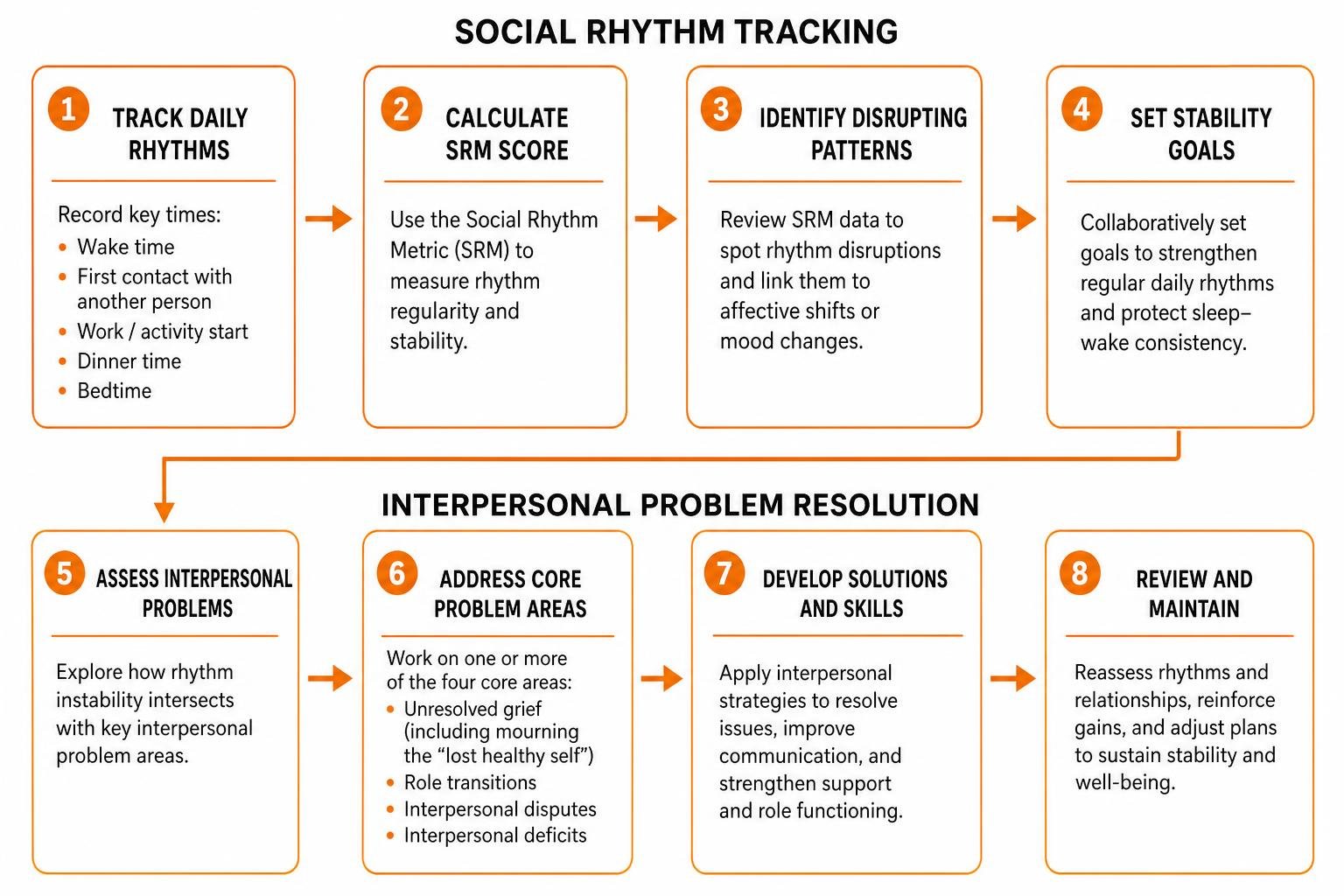
Clinicians utilize the Social Rhythm Metric (SRM), an objective tracking system where patients record daily wake times, first contact with another person, work or daily activity start times, dinner times, and bedtimes. Patients examine how rhythm disruption triggers affective shifts while addressing four core interpersonal problem areas: unresolved grief (including mourning the "lost healthy self"), role transitions, interpersonal disputes, and interpersonal deficits. Evidence highlighted in clinical evidence for IPSRT confirms that acute weekly IPSRT lengthens time to recurrence and sustains vocational performance during long-term maintenance.
Psychoeducation and Illness Literacy
Structured individual psychoeducation moves beyond simple information delivery to create practical illness management skills. Clinicians guide patients through active symptom mapping to identify subtle prodromal indicators—such as subtle shifts in sleep duration, altered speech cadence, or sudden increases in goal-directed activity—well before full-blown affective episodes manifest.
Randomized trials reveal that individual psychoeducation significantly extends the time to a first manic relapse and improves occupational and social functioning over 18 months. When delivered by clinicians with structured protocols, even brief psychoeducational programs (e.g., 5 to 9 sessions) provide measurable gains in illness knowledge and substantially increase the total number of "well weeks" experienced over a calendar year.
Core Mechanisms: How Psychotherapy Complements Medication
Psychotherapy does not act in opposition to pharmacological stabilization; rather, it functions synergistically with it. Psychotherapeutic interventions build behavioral guardrails around daily biological rhythms, mitigate environmental distress, and foster active treatment engagement.
Our licensed doctoral- and master's-level clinicians integrate these evidence-based modalities directly into flexible, outcome-tracked care through virtual telehealth care packages, allowing patients to build stability within their home environments.
Daily Social Rhythm Regulation and Circadian Stability
Bipolar disorder involves heightened vulnerability to circadian clock desynchronization. Environmental time-givers, known as zeitgebers (e.g., sunrise, meal times, social interactions), entrain our central biological pacemakers. Conversely, social zeitstorers—events that disturb routine schedules, such as shift work, transmeridian travel across time zones, or late-night social gatherings—can destabilize circadian architecture and rapidly trigger manic or depressive shifts.
Through structured tracking, individual therapy trains patients to keep their sleep-wake schedules, light exposure, and daily activity windows consistent within narrow timeframes. This behavioral regularity shields the circadian system against unexpected environmental disruptions, stabilizing neural circuits that medication alone cannot fully regulate.
Addressing Interpersonal Stress and Family Dynamics
Social friction and environmental hostility are primary contributors to bipolar episode recurrence. Extensive clinical literature demonstrates that individuals living in environments characterized by high expressed emotion (hostility, chronic criticism, or emotional overinvolvement) face a two- to three-fold higher risk for illness recurrence over one to two years compared to individuals in low expressed emotion settings.
Individual psychotherapy provides targeted communication training, assertiveness skills, and boundary-setting strategies. By learning conflict-de-escalation techniques, patients can manage difficult relationships, protect themselves from interpersonal friction, and build supportive networks that enhance stability.
Enhancing Pharmacological Adherence and Side-Effect Literacy
Medication nonadherence represents one of the most substantial clinical challenges in bipolar management. Up to 50% of individuals discontinue mood stabilizers prematurely due to medication ambivalence, intolerable side effects (such as cognitive dulling, weight gain, or tremors), or the seductive appeal of hypomanic productivity.
Within individual therapy, clinicians create an open, nonjudgmental space to unpack medication ambivalence. Therapists address cognitive distortions regarding pharmacology (e.g., "Needing medication means I am fundamentally weak"), facilitate problem-solving for side-effect management, and collaborate directly with prescribing psychiatrists to refine treatment regimens before nonadherence precipitates a crisis.
Clinical Tailoring and Implementation Strategies
Providing effective psychotherapeutic support requires tailoring evidence-based protocols to each person's illness stage, clinical presentation, and co-occurring conditions. A standardized approach often fails to address unique symptom variations, making individualized assessment essential.

Our team regularly covers clinical adjustments and psychological wellness strategies across our blog resources, underscoring how individualized treatment plans lead to lasting outcomes.
Adapting Individual Therapy for Bipolar Disorder Across Subtypes
Therapeutic approaches must adapt significantly depending on whether a patient presents with Bipolar I or Bipolar II Disorder:
- Bipolar I Disorder: Therapy focuses on early recognition of manic prodromes, strict sleep-wake stabilization, and harm-reduction protocols for impulsivity, grandiosity, and hypersexuality. Relapse prevention requires concrete action steps to restrict access to credit cards, vehicle keys, or high-risk business decisions during escalating phases.
- Bipolar II Disorder: The clinical course is predominantly characterized by protracted, treatment-resistant depressive episodes and subtle hypomania. Psychotherapy focuses on cognitive restructuring for depressive schemas, behavioral activation that avoids overstimulation, and managing residual dysthymia. Clinical adaptations explored in IPSRT adaptations for bipolar II highlight the value of tracking hypomanic shifts, which patients often perceive as productive states rather than mood instability (Swartz et al., 2012).
Furthermore, therapists must screen for and treat comorbid conditions—such as generalized anxiety disorder, substance use disorders, and ADHD—which occur in more than 50% of bipolar cases and complicate long-term stability.
Structuring Relapse Prevention in Individual Therapy for Bipolar Disorder
A central outcome of individual therapy is the creation of a personalized Relapse Prevention Plan. This structured framework translates clinical insights into immediate action when prodromal warning signs emerge:
- Prodromal Signature Mapping: Documenting individualized warning signs across depressive (e.g., changes in appetite, social withdrawal, feelings of worthlessness) and hypomanic/manic phases (e.g., decreased need for sleep without fatigue, racing speech, rapid multitasking).
- Tiered Action Triggers: Establishing clear action steps tied to specific symptoms (e.g., "If sleep drops below 5 hours for two consecutive nights, execute Step 1: notify prescribing provider and adjust evening medication as directed").
- Digital Mood and Sleep Tracking: Integrating mobile tracking tools to monitor daily mood fluctuations, social rhythm indices, and sleep architecture, generating objective data for regular clinical review.
- Crisis Intervention and Advance Directives: Outlining clear medical preferences, designated healthcare proxies, and safety protocols in the event of severe depressive suicidality or manic psychosis.
- Environmental Optimization: Structuring the home and work environment to limit chaotic shifts, reduce unmanaged sensory overload, and maintain daily routines.
Frequently Asked Questions about Bipolar Psychotherapy
Can psychotherapy replace mood stabilizers for bipolar disorder?
No. Psychotherapy serves as an adjunctive intervention and cannot safely replace mood-stabilizing medications for bipolar disorder. Bipolar disorder is a biological, neurochemical condition characterized by shifts in brain structure, circadian genes, and neurotransmitter pathways. Psychotherapy provides the behavioral, emotional, and cognitive tools to manage the illness, identify early warning signs, and maintain daily routines, but medications provide the essential neurochemical foundation to prevent severe manic and depressive episodes.
You can find more answers regarding treatment integration and teletherapy services in our frequently asked questions section.
How does individual therapy compare to family therapy?
Individual therapy and Family-Focused Therapy (FFT) address different aspects of bipolar management. Individual therapy allows for private exploration of personal goals, trauma, internal cognitive distortions, and customized daily routine planning without external influence.
In contrast, family therapy directly addresses systemic interpersonal dynamics, reduces expressed emotion, and trains family members in collective crisis management. Component network meta-analyses show that while family therapy yields lower study attrition and strong outcomes in conflict-heavy households, individual therapy offers targeted space for self-reflection and personalized behavioral interventions.
When in the illness course is psychotherapy most effective?
Psychotherapy is most effective when introduced early in the illness course. Clinical evidence shows that interventions like CBT are particularly successful for patients with fewer than 12 prior affective episodes, before recurrent mood episodes cause significant cognitive changes or disrupt career and relationship foundations.
However, individuals with long-standing illness still gain substantial benefits—particularly through IPSRT and structured psychoeducation—by learning to manage social rhythms, reduce residual depressive symptoms, and avoid hospitalizations.
Conclusion
Achieving sustained stability with bipolar disorder requires a balanced, multifaceted treatment model. While pharmacotherapy helps balance underlying neurochemistry, individual therapy provides the daily structure, cognitive tools, and lifestyle habits needed to navigate life's challenges. Combining evidence-based psychotherapy with medical care offers a comprehensive path toward lasting wellness.
At All Points North Telehealth Therapy, our licensed clinicians provide personalized, HIPAA-compliant care designed to meet your specific needs. Through outcome-tracked sessions and coordinated clinical oversight, our team helps you develop sustainable daily routines, identify early mood shifts, and maintain long-term stability.
To take the next step in your care, connect with our team to learn more about our individual therapy services today.
References
Yilmaz S, Huguet A, Kisely S, Rao S, Wang J, Price M, Morriss R, Inder M, Perich T, Wright K. "The clinical efficacy of psychological interventions for bipolar depression: a systematic review and individual patient data (IPD) meta-analysis.." Psychological medicine, 2025. PMCID PMC12115277. Swartz HA, Levenson JC, Frank E. "Psychotherapy for Bipolar II Disorder: The Role of Interpersonal and Social Rhythm Therapy.." Professional psychology, research and practice, 2012. PMCID PMC4657867.