Why Family Therapy for Blended Families Is the Best Step Toward Household Harmony
How Family Therapy for Blended Families Can Help

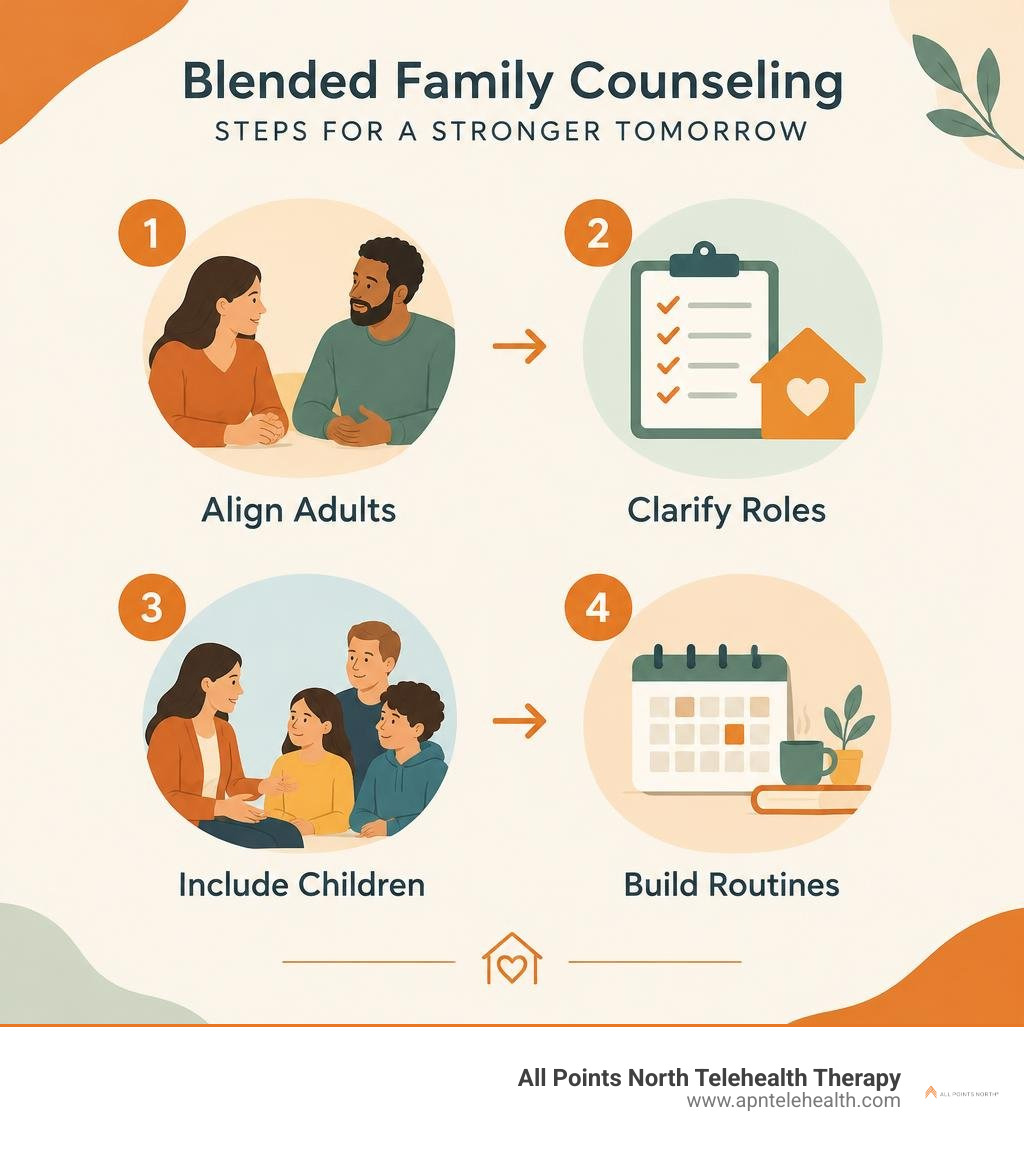
Family therapy for blended families helps parents, stepparents, and children work through new roles without forcing close bonds before they are ready. Start by agreeing on household rules and who handles discipline. A therapist can then help family members talk through loyalty conflicts, listen to each other, and build routines that respect their existing relationships.
You do not need to bring everyone to every session. Some families begin with the adults, then include children when it would help. Blending a household takes time; the goal is steady progress, not instant harmony.
Combining two distinct household cultures into one cohesive home is rarely a straightforward journey. Many people joke that a blended family is like a "step-casserole"—everyone tosses their own distinct ingredients, secret spices, and culinary habits into the same baking dish and hopes it turns out edible. In reality, modern demographic shifts show just how common this dynamic has become.
Today, married couples represent less than half of all American households, and only about a fifth of households consist of married couples raising children together in a traditional first-marriage structure. Roughly half of all children in the United States will live in a single-parent home at some point before they turn 18, and 28% of mothers with two or more children have children with at least two different fathers. In 2013, over 40% of US babies were born outside marriage, with 27% of children living in fatherless homes.
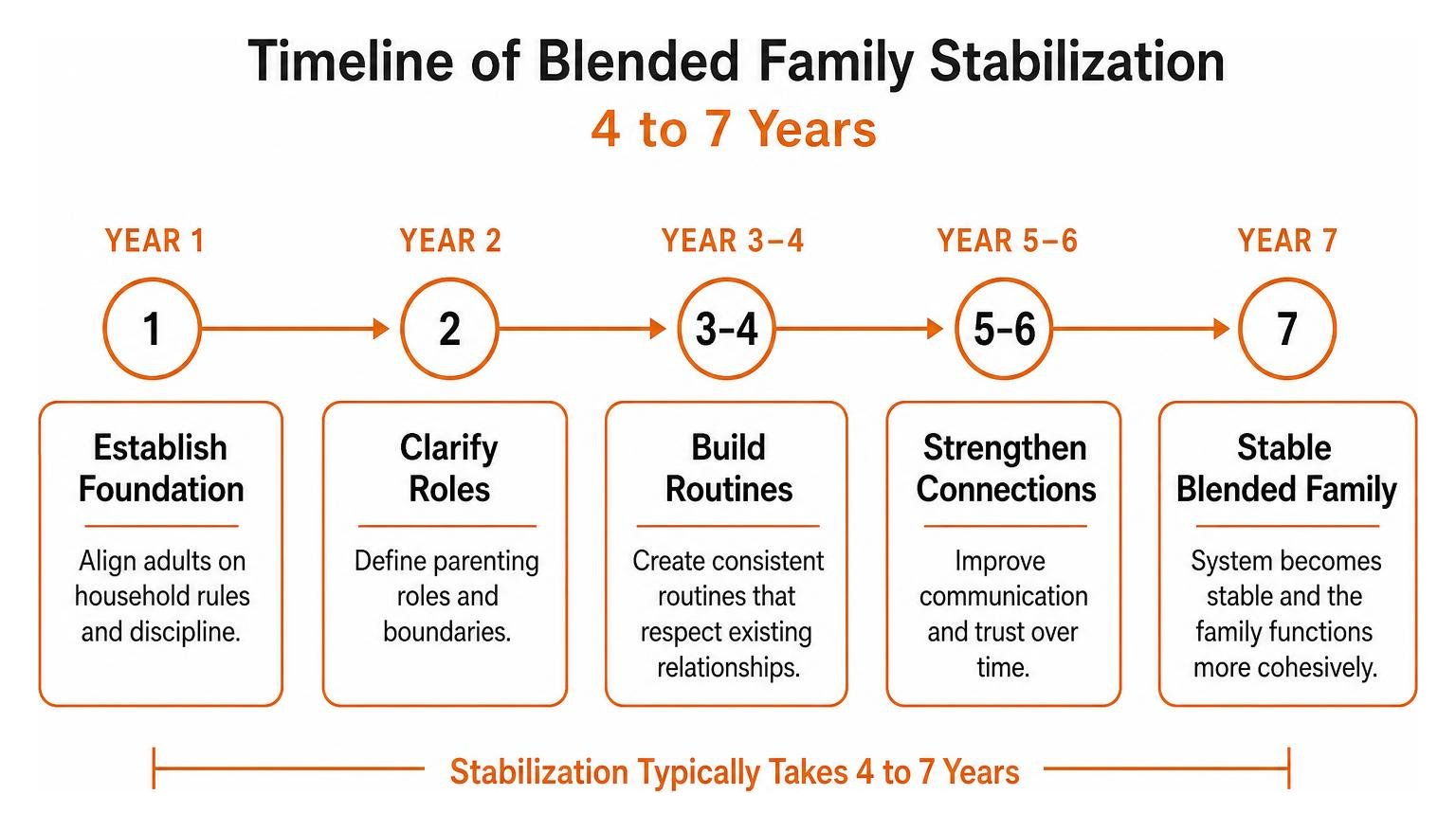
As single parents form new partnerships, stepfamilies have rapidly become one of the most prominent family structures. Yet longitudinal research indicates that stepfamily systems typically require four to seven years to fully stabilize. Navigating loyalty binds, grieving lost routines, and figuring out who enforces bedtime can leave everyone feeling overwhelmed.
Unique Pressures: Why Stepfamilies Face Distinct Relationship Hurdles
Blended families do not operate like nuclear families, and expecting them to function identically sets everyone up for frustration. When two adults combine households, they bring distinct histories, established parenting habits, and lingering emotional baggage. Cohabitation friction often flares over everyday logistics: chore divisions, dietary preferences, screen time rules, and curfews.

Clashes over parenting styles are among the most volatile hurdles. One partner may practice an authoritative, structured approach, while the other leans toward permissive parenting out of guilt over a past divorce or separation. Without clear alignment, children quickly pick up on inconsistencies, leading to behavioral testing and partner resentment.
The Emotional Pivot: Loyalty Binds, Loss, and Detachment
Beneath surface-level arguments over chores or bedtime rules lie complex emotional undercurrents. Every member of a stepfamily has experienced some form of loss—the dissolution of an original family unit, the loss of sole parental attention, or the disruption of familiar routines.
Children, especially adolescents, frequently navigate acute loyalty binds. A child may worry that showing affection to a stepparent betrays their biological parent living in another home. As highlighted in blended family alignment research, this internal conflict often manifests as:
- Emotional detachment: Pulling away from family activities or becoming uncommunicative.
- Academic decline: Sudden drops in school performance due to cognitive and emotional overwhelm.
- Triangulation: Pitting parents against stepparents to regain a sense of control.
- Parental guilt: Biological parents overcompensating with lenient rules, which alienates the stepparent.
Addressing these dynamics requires understanding that resistance is rarely personal; it is a protective response to change. When working through these transitions, partners can recognize that empathy and unified leadership must precede behavioral correction.
Cultural Expectations, Legal Gaps, and the "Family of Choice"
Unlike traditional families, whose bonds are reinforced by automatic legal, medical, and societal recognition, stepfamilies frequently navigate ambiguity. Stepparents often step up to provide daily care, transportation, and emotional support, yet they may lack legal authority to sign school forms, access medical records, or make emergency decisions.
Furthermore, societal stereotypes often frame stepfamilies through outdated narratives—ranging from the "wicked stepmother" trope to unrealistic sitcom ideals of instant love. In therapy, we reframe the household as a "family of choice." Family is not solely defined by consanguinity (blood ties); it is forged through intentional affinity, mutual respect, and shared commitments. Validating this distinction relieves stepparents of the impossible pressure to replace a biological parent and frees stepchildren from the expectation of instant affection.
Core Modalities and Techniques in Family Therapy for Blended Families
Standard counseling frameworks often fall flat when applied to stepfamilies because they assume an existing, shared history. Specialized therapy for blended systems relies on evidence-based models that honor multiple subsystems, past attachments, and distinct developmental speeds.
Clinical interventions draw heavily from Family Systems Theory, the Satir Growth Model, and Emotionally Focused Family Therapy (EFFT). Targeted therapeutic workshops addressing couple bonds, loyalty conflicts, divided parenting tasks, and new family culture can significantly improve psychological well-being, attachment security, and resilience.
Emotionally Focused Therapy and Structural Realignment
Emotionally Focused Therapy helps family members identify the negative interaction cycles that drive conflict. When a stepparent demands stricter discipline, they may actually be expressing a fear of being excluded or disrespected. When a stepchild lashes out, they may be signaling fear of losing their biological parent's love.
Therapists map these vulnerability cycles to help family members express core attachment needs rather than reactive anger. Structurally, therapy restores a healthy hierarchy:
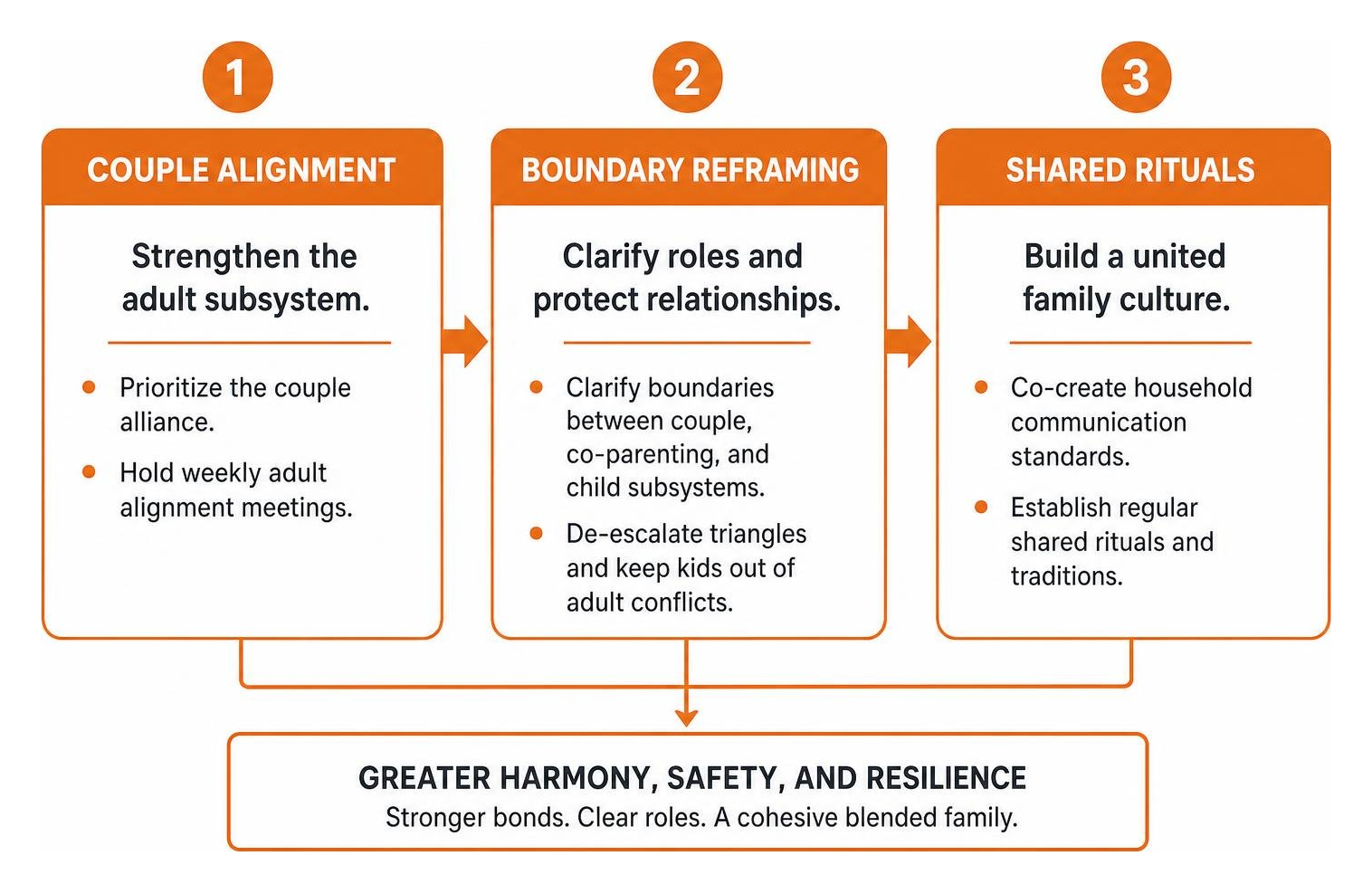
- Strengthening the Adult Subsystem: Ensuring the parental team is solid and collaborative.
- Clarifying Boundaries: Defining clear lines between the couple's relationship, co-parenting roles with ex-partners, and child subsystems.
- De-escalating Triangles: Removing children from the middle of adult financial, legal, or emotional conflicts.
Restructuring Communication: Conversation vs. Conformity Orientations
Every family develops a unique communication orientation:
- Conversation Orientation: The degree to which families encourage open, unrestrained discussions about all topics, feelings, and decisions.
- Conformity Orientation: The degree to which families emphasize uniformity of beliefs, obedience, and harmony over individual expression.
When a parent from a high-conversation household merges with a partner from a high-conformity household, friction is inevitable. Therapy bridges this gap by establishing emotional safety, teaching active listening, and co-creating shared household communication standards. You can read more practical relationship and communication strategies on our blog.
A Step-by-Step Blueprint for Establishing Household Harmony
Achieving balance in a stepfamily does not happen by accident. It requires a systematic approach that reduces ambiguity, protects individual relationships, and establishes a united home culture.
Step 1: Solidifying the Couple Coalition Before Whole-Family Intervention
The romantic relationship is the foundation of the entire blended family structure. Research in family psychology consistently shows that a strong couple alliance predicts overall stepfamily cohesion far more reliably than immediate stepparent-stepchild bonding. If the adults are divided on discipline, schedules, or boundaries with ex-spouses, the entire household feels unstable.
- Schedule weekly adult alignment meetings to review household logistics, financial arrangements, and co-parenting interactions.
- Present a united front on core rules, even when disagreements arise behind closed doors.
- Establish clear boundaries regarding ex-partners to prevent outside interference from destabilizing the marriage.
- Process individual stress, past grief, or personal parenting triggers through individual therapy so you do not carry unresolved emotional weight into joint parenting decisions.
Step 2: Implementing Family Therapy to Reframe Boundaries
Once the adults are aligned, therapy helps clarify day-to-day roles. In the early stages of blending, the most effective approach is often for the biological parent to remain the primary disciplinarian, while the stepparent focuses on building rapport and connection—acting more like a supportive aunt, uncle, or mentor rather than an immediate authority figure.
Therapy provides a structured space to:
- Clarify that stepparents are authority figures deserving of basic respect, but biological parents manage primary consequences and rule enforcement.
- Negotiate emotional boundaries, giving stepchildren permission to warm up at their own pace without forced affection.
- Create distinct physical and personal spaces for all children within the shared home.
Step 3: Establishing Shared Family Rituals and Micro-Connections
Cohesion grows through shared, positive experiences rather than forced unity. Instead of erasing pre-existing family traditions, healthy blended families honor past customs while co-creating new rituals.
- Micro-Connections: One-on-one "dates" between biological parents and their children, as well as low-pressure activities between stepparents and stepchildren (e.g., shared hobbies, cooking together, or casual walks).
- Shared Rituals: Creating new weekly traditions, such as movie nights, game sessions, or unique holiday traditions that combine elements from both original families.
- Step-Sibling Bonding: Allowing step-siblings time to develop their own relationships without forcing them to act like best friends immediately.
Comparing Therapeutic Formats: Which Structure Fits Your Household?
Every blended family enters therapy at a different stage of development. Assessing which clinical format best matches your current needs ensures that treatment is productive without overwhelming family members.

Assessing Formats for Stepfamily Care
Therapy may combine couple alignment, individual support, and multi-member family sessions depending on your household's dynamic:
| Therapy Format | Primary Clinical Focus | Ideal Household Scenario | Expected Outcomes |
|---|---|---|---|
| Couples Alignment Therapy | Parenting consistency, boundary setting with exes, marital bond | Adults disagreeing on discipline, feeling overwhelmed, or experiencing marital tension | Unified front, reduced power struggles, strong adult partnership |
| Multi-Member Family Therapy | Whole-system communication, role clarification, ritual creation | Sibling conflict, household transitions, behavioral disruptions in the home | Clear expectations, healthy communication patterns, improved cohesion |
| Individual Counseling (Child/Adult) | Loyalty binds, grief, personal adjustment, anxiety, parental guilt | An individual child acting out or a stepparent feeling burnt out and isolated | Emotional regulation, reduced loyalty distress, personal coping tools |
At All Points North Telehealth Therapy, our master's- and doctoral-level clinicians conduct thorough assessments to design customized care plans. We offer versatile telehealth care packages that make it simple to combine individual, couples, and family sessions into a coordinated plan.
Frequently Asked Questions About Stepfamily Counseling
If you have additional questions about clinical scheduling, insurance coverage, or technology requirements, you can find clear answers in our frequently asked questions section.
How long does it typically take for a blended family system to stabilize?
Full integration is a multi-year process. Longitudinal studies indicate that most blended families take between four and seven years to establish a stable, mature system identity. However, families engaging in structured therapy typically experience meaningful reductions in daily conflict, improved communication, and clearer boundaries within three to six months of consistent treatment.
Should stepchildren attend every therapy session?
No. In fact, bringing children into sessions before the adults are aligned can sometimes increase household stress. Clinical best practice often involves starting with the adult subsystem to establish parenting agreements and communication ground rules. Children and step-siblings are brought into sessions strategically to address specific communication patterns, build shared routines, or resolve specific relational hurdles.
Can online counseling effectively resolve stepfamily conflict?
Yes. Virtual teletherapy is highly effective for blended families. Telehealth allows parents who share custody across multiple households to participate in joint sessions without logistical stress or travel friction. It also allows busy adolescents to join sessions comfortably from home. Our secure, HIPAA-compliant platform ensures complete clinical privacy while providing seamless access to licensed therapists specializing in stepfamily dynamics.
Conclusion
Blending a family requires patience, intentional communication, and a willingness to let relationships develop organically. You do not have to navigate loyalty binds, co-parenting challenges, and household adjustments alone. At All Points North Telehealth Therapy, our licensed clinicians provide personalized, outcome-tracked care designed to help stepfamilies build lasting harmony. When you are ready to take the next step toward a peaceful, aligned home, schedule specialized family therapy with our team today.