How Family Therapy Helps Dementia Families

Look for a licensed family therapist with experience in dementia care. Ask whether they can meet with caregivers together, include the person with dementia when appropriate, and offer secure online sessions if travel is hard. A useful first goal is simple: agree on how to talk about changes, share care tasks, and handle disagreements.
Memory loss affects more than one person. As needs change, family roles change too. Therapy gives loved ones a place to make decisions together, support the main caregiver, and adjust their plans over time. It cannot stop dementia, but it can help a family face it with less confusion and conflict.
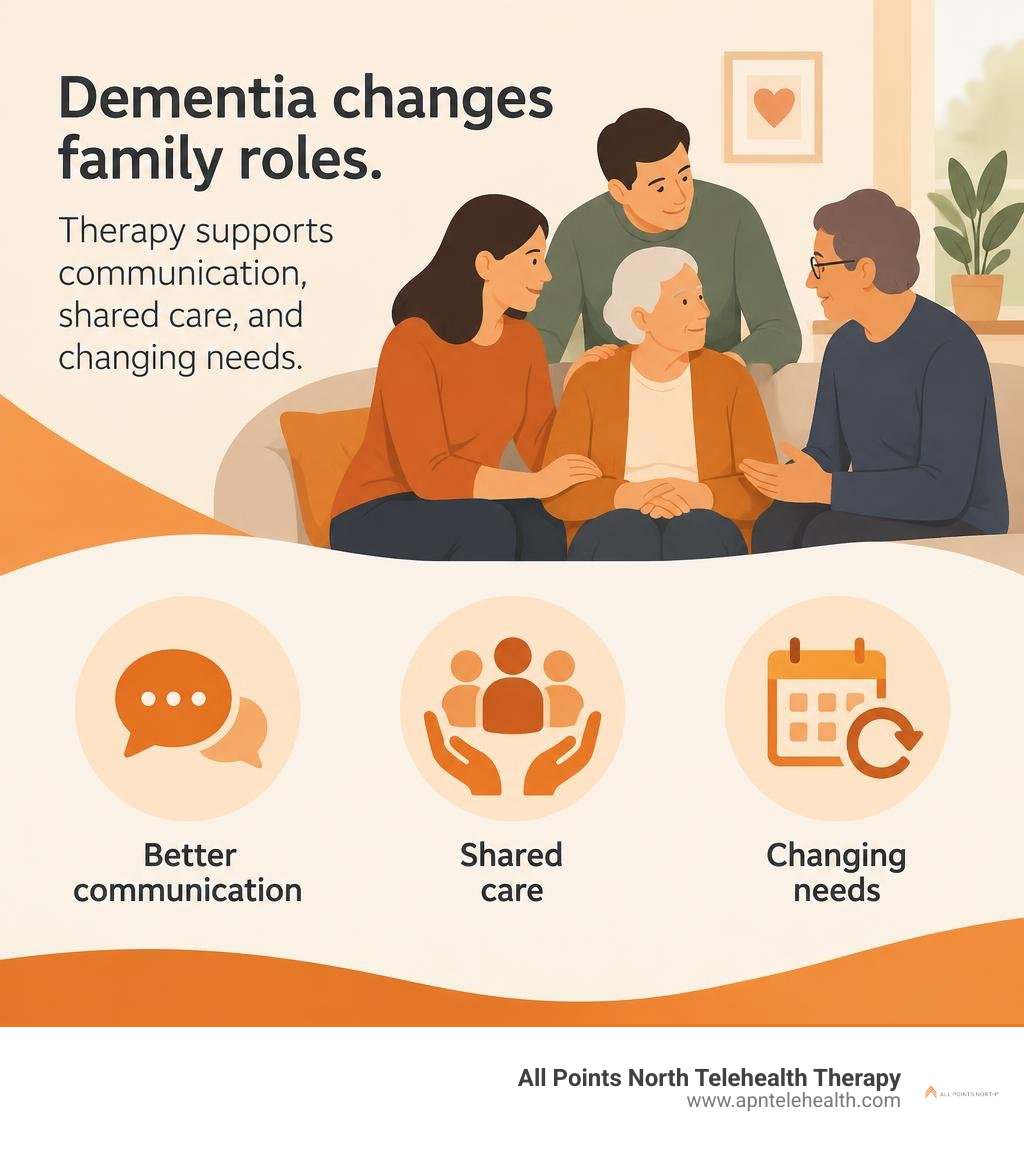
With approximately 10 million new dementia cases diagnosed globally each year, progressive cognitive decline represents one of the most pressing health challenges families face. Crucially, around 94% of people with dementia receive care at home. This places a monumental responsibility on spouses, adult children, and extended family members. When neurodegenerative conditions emerge, they disrupt established relationship patterns, trigger ambiguous loss, and frequently cause systemic burnout. Recognizing these dynamics, modern clinical practices emphasize that dementia is not merely an individual illness, but a shared familial experience that requires coordinated emotional and practical adaptation. Family therapy for dementia families offers a structured way to build that coordination, helping loved ones navigate changing roles while preserving dignity and connection.
The Core Framework of Family Therapy for Dementia Families
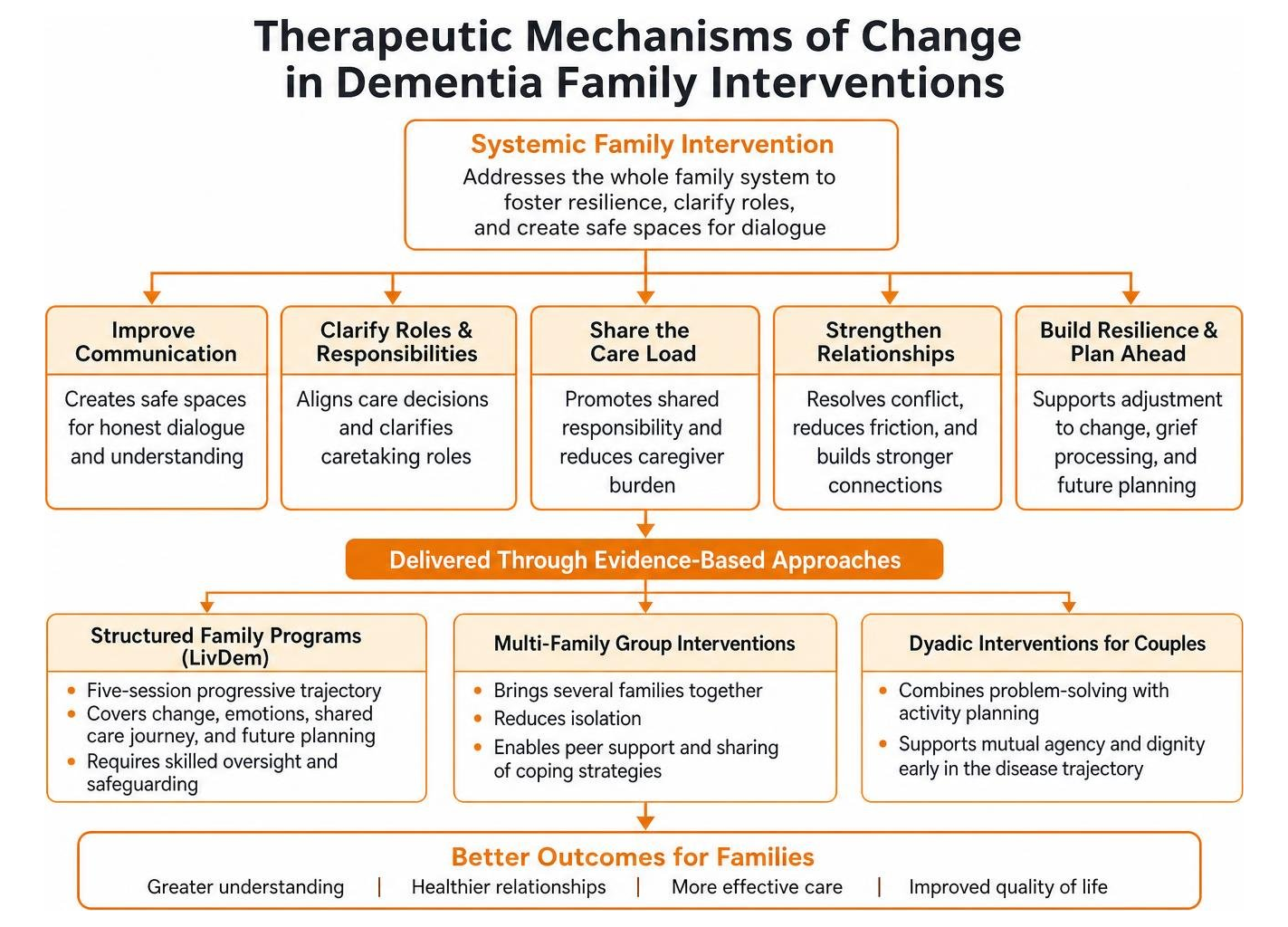
Systemic family therapy conceptualizes the household as an interconnected emotional unit. When one member experiences progressive cognitive impairment, every relational bond undergoes strain. Traditional medical care frequently centers exclusively on symptom management for the patient, leaving loved ones to navigate complex care routines in isolation. By contrast, systemic family interventions address the entire relational system, fostering resilience, clarifying caretaking responsibilities, and establishing safe emotional spaces for honest dialogue.

A structured approach to relational adjustment is exemplified by the LivDem group intervention to support families to talk together. Adapted from proven dementia psycho-educational models, this framework provides a five-session progressive trajectory covering change, emotional reactions, the shared care journey, and future planning. Feasibility trials of the LivDem-families adaptation demonstrated exceptional acceptability, with mean participant ratings reaching 19.3 out of 20.
However, because structured family discussions about prognosis and shifting dependency can evoke intense emotional reactions—including rare disclosures of severe distress or self-harm—clinicians emphasize the necessity of skilled therapeutic oversight, pre-participation relationship screening, and robust safeguarding protocols.
Systemic Approaches vs. Individual Caregiver Support
While individual counseling provides vital emotional validation for primary caregivers, it cannot directly repair the interpersonal friction or misaligned expectations that occur across a broader family unit. Systemic approaches bring multiple family members into structured dialogue, promoting shared decision-making and preventing a single relative from shouldering the entire physical and psychological burden.
| Feature | Individual Caregiver Support | Family Therapy for Dementia Families |
|---|---|---|
| Primary Focus | Personal stress, isolated coping, caregiver burnout | Relational dynamics, systemic adaptation, shared care load |
| Participants | Primary caregiver and clinician | Primary caregiver, person with dementia (when appropriate), siblings, extended family |
| Interpersonal Goals | Enhancing self-care and emotional venting | Resolving role conflict, aligning care decisions, improving communication |
| Intervention Scope | Symptom-level distress reduction | Long-term family restructuring, grief processing, boundary negotiation |
| Dyadic Inclusivity | Minimal direct engagement with care recipient | Direct engagement with dyads to support mutual agency and dignity |
Multi-Family Group Formats and Dyadic Interventions
Multi-family group interventions extend systemic principles by bringing several affected families together. This format reduces the profound social isolation that dementia often brings, allowing relatives and care recipients to observe peer modeling and share practical coping strategies.
For couples navigating early cognitive decline, dyadic programs combine collaborative problem-solving with tailored activity planning. Research evaluating the Daily Enhancement of Meaningful Activity (DEMA) model in the pilot study on Satisfaction With a Family-Focused Intervention for Mild Cognitive Impairment Dyads (Lu et al., 2016) revealed that persons with mild cognitive impairment (PwMCI) reported significantly higher perceived usefulness (mean score of 4.1 vs. 3.6, p =.025) and ease of use (4.1 vs. 3.7, p =.038) compared to informational support controls. Integrating structured problem-solving into meaningful daily routines strengthens dyadic partnerships early in the disease trajectory.
Evidence-Based Modalities and Key Mechanisms of Change
Modern clinical pathways incorporate specialized modalities designed to target the cognitive, behavioral, and emotional shifts caused by progressive memory loss. Families can explore additional clinical perspectives and self-care strategies through our therapeutic resources on the blog.
Acceptance and Commitment Therapy in Family Therapy for Dementia Families
Acceptance and Commitment Therapy (ACT) has emerged as a potent modality for dementia care networks. Rather than attempting to suppress painful thoughts regarding a loved one's decline, ACT cultivates psychological flexibility—the capacity to stay present with uncomfortable emotions while taking values-based action.
Clinical research investigating the Preliminary efficacy of an online intervention based on Acceptance and Commitment Therapy for family caregivers documented profound improvements across longitudinal follow-ups:
- Caregiver Stress: Significant reductions at 6-month follow-up (mean difference: -6.00, Cohen's d = -1.13).
- Caregiver Anxiety: Clinically meaningful drops in anxiety symptoms (mean difference: -5.55, d = -1.38).
- Depressive Symptoms: Marked alleviation of depression scores (mean difference: -3.34, d = -0.78).
- Psychological Flexibility: Substantial gains on the FIT-60 scale (mean difference: 31.53).
- Sense of Competence: Measurable increases in caregiving self-efficacy (mean difference: 1.10, d = 0.45).
By targeting experiential avoidance and instilling mindfulness, ACT equips families to accept unavoidable cognitive losses while investing in meaningful relational moments.
Cognitive Rehabilitation and Multi-Family Group Protocols
For early-stage impairment, combining cognitive rehabilitation with multi-family group dynamics produces measurable functional benefits. In a comprehensive trial examining the Cognitive Rehabilitation Multi-family Group Intervention for Individuals with Mild Cognitive Impairment and Their Care-Partners, dyads engaged in a 3-month program consisting of individual joining sessions, an educational workshop, and 20 twice-weekly multifamily memory strategy training and problem-solving sessions.
Participants with MCI demonstrated significant post-test performance improvements on objective neurocognitive memory tests and performance-based measures of everyday functioning. Concurrently, care-partners self-reported significantly enhanced coping behaviors, illustrating that collaborative compensatory training preserves functional independence and dyadic stability.
Relational Mechanisms and Communication Dynamics in Family Therapy for Dementia Families
Therapeutic gains in systemic dementia care operate through distinct relational mechanisms:
- Shifting from Correction to Validation: Families learn to abandon confrontational "reality orientation" in favor of validating emotional truths, reducing catastrophic behavioral reactions.
- Deconstructing Triangulation: Stress often leads two family members to unite against a third (such as siblings criticizing the primary caregiver spouse); therapy uncovers and resolves these destructive patterns.
- Processing Anticipatory Ambiguous Loss: Therapists guide relatives through the paradox of grieving someone who is still physically present but psychologically altered.
- Restructuring Care Roles: Tasks are systematically distributed across family members based on practical availability, preventing primary caregiver resentment and exhaustion.
Adapting Interventions for Telehealth Delivery and Overcoming Adherence Barriers
Delivering therapy directly into the home via virtual platforms resolves major logistical hurdles, such as arranging respite care or transporting an easily disoriented loved one to a clinic.

According to a meta-analysis on the Effectiveness of Technology‐Delivered Psychosocial Interventions for Family Caregivers of Patients With Dementia: A Systematic Review, Meta‐Analysis and Meta‐Regression - Cheng - 2024 - International Journal of Mental Health Nursing - Wiley Online Library, technology-delivered interventions yield statistically significant reductions in caregiver depression (Hedges' g ≈ 0.20) and overall stress, with an average weighted post-intervention effect size for caregiver stress of 0.26 (95% CI [0.18, 0.33]).
Virtual Accessibility, Dropout Rates, and Digital Care Formats
Despite high efficacy, virtual delivery faces adherence challenges. Research reveals an overall pooled dropout rate of 18.4% (95% CI [13.5%, 24.5%]) across digital caregiver interventions, with approximately one out of five participants leaving prematurely. Caregivers cite unsuitable content, technological friction, time constraints, and the emotional burden of self-guided modules as primary reasons for disengagement.
To overcome these barriers, interventions must offer intuitive platforms, flexible scheduling, and structured clinician guidance. Families can explore our customized telehealth care packages to access personalized, clinician-led virtual therapy sessions tailored directly to their unique household circumstances.
Motivational Coaching, Goal Setting, and Booster Sessions
Longitudinal adherence and skill retention increase significantly when self-guided digital learning is paired with brief motivational coaching calls. Incorporating initial SMART (Specific, Measurable, Achievable, Relevant, Time-bound) goal-setting sessions helps caregivers pinpoint actionable priorities. Furthermore, scheduled monthly booster sessions provide essential check-ins to troubleshoot emerging behavioral challenges and prevent relational drift over time.
Addressing Disease Progression, Caregiver Trajectories, and Research Gaps
Dementia is not a static condition; it demands evolving clinical strategies as neurodegeneration advances across mild, moderate, and severe stages.
Staged Care Strategies from Early Impairment to Advanced Dementia
Early-stage interventions focus on memory compensation, dyadic communication, and advance care planning. In moderate stages, therapy shifts toward managing behavioral expressions (such as agitation or wandering) and establishing sustainable respite routines.
In late and advanced stages, therapeutic focus shifts to palliative comfort and sensory engagement. In a cluster randomized controlled trial investigating the Namaste Care Family for people with dementia and family−A randomized controlled trial, an intervention combining sensory touch, soothing environments, and family involvement was evaluated for nursing home residents. While the study did not observe statistically significant changes in overall resident quality of life (QUALID) or caregiver burden scores, residents in the intervention group experienced:
- Significant Reductions in Discomfort: Mean discomfort reduction of -1.06 (95% CI [-1.88, -0.23]).
- Fewer Sentinel Health Events: A significant drop in acute complications (-0.40; 95% CI [-0.64, -0.16]), including lower pneumonia rates.
- Decreased Family-Staff Conflict: Caregiver conflict with care facility staff was significantly lower at 12-month follow-up (-2.04; 95% CI [-4.07, -0.01]).
These findings demonstrate that structured family-centered programs enhance physical comfort and ease systemic institutional friction during late-stage care.
Limitations of Current Evidence and Future Clinical Directions
While existing literature validates the utility of systemic dementia therapy, several methodological limitations persist:
- Small Sample Sizes: Many pilot trials feature limited cohorts, restricting statistical power.
- Selection Bias: Research samples frequently overrepresent highly motivated, non-Hispanic white female caregivers, highlighting an urgent need for diverse cultural adaptations.
- Limited Long-Term Tracking: Few studies evaluate outcomes beyond 6 to 12 months, leaving gaps in our understanding of multi-year disease trajectories.
- Lack of Cost-Effectiveness Data: Future large-scale randomized trials must evaluate whether systemic teletherapy reduces healthcare costs by delaying nursing home placement.
Frequently Asked Questions About Dementia Family Interventions
To learn more about therapy logistics and expectations, read through these additional answers to common care questions.
How does family therapy differ from individual caregiver counseling?
Individual caregiver counseling focuses primarily on the emotional coping, stress relief, and personal boundaries of one person. In contrast, family therapy works with the entire relational system. It directly addresses sibling conflict, care coordination, dyadic communication between partners, and the shared navigation of progressive memory loss.
Can online family interventions effectively reduce caregiver anxiety and stress?
Yes. Clinical trials evaluating virtual Acceptance and Commitment Therapy (ACT) demonstrate large, clinically significant reductions in caregiver stress (d = -1.13) and anxiety (d = -1.38) at 6-month follow-up, alongside significant increases in psychological flexibility and sense of competence.
What strategies sustain therapeutic gains as dementia advances?
Sustaining therapeutic benefits requires adapting strategies to the disease stage. Key practices include attending periodic booster coaching sessions, using structured SMART goal planning, transitioning from verbal debate to emotional validation, and incorporating sensory-based comfort routines in advanced stages.
Conclusion
Facing progressive memory loss within a family is one of life's most challenging journeys, but no household has to navigate it alone. Systemic family therapy equips loved ones with practical communication strategies, evidence-based coping skills, and a unified care plan that honors the dignity of the person with dementia while shielding caregivers from isolation and burnout.
At All Points North Telehealth Therapy, our licensed, master's- and doctoral-level clinicians provide HIPAA-compliant virtual care designed to support your family's unique needs. We deliver outcome-tracked, evidence-based therapy with coordinated clinical oversight and seamless access to our broader continuum of specialized care. Contact us today to explore our accessible family therapy and begin building lasting resilience for your family.
References
Lu YY, Ellis J, Yang Z, Weaver MT, Bakas T, Austrom MG, Haase JE. "Satisfaction With a Family-Focused Intervention for Mild Cognitive Impairment Dyads.." Journal of nursing scholarship : an official publication of Sigma Theta Tau International Honor Society of Nursing, 2016. PMCID PMC4970320.