Master Workplace Stress with Modern Anxiety Therapy for Professionals
Understanding Anxiety Therapy for Professionals: Root Causes and Triggers

Anxiety therapy for professionals directly targets the nervous system dysregulation and cognitive pressures that arise in high-stakes careers. Evidence-based modalities such as Cognitive Behavioral Therapy (CBT), Acceptance and Commitment Therapy (ACT), and Eye Movement Desensitization and Reprocessing (EMDR) help high achievers manage perfectionism, overthinking, and emotional reactivity. By addressing both the physiological stress response and the thought patterns that fuel it, this specialized therapy restores resilience and sustainable performance.
High-pressure career environments place immense, unyielding demands on mental bandwidth. When deadlines mount and stakes rise, many high-achieving individuals operate under an unspoken rule: perform at all costs. The World Health Organization has explicitly recognized occupational stress as a major risk factor for chronic health problems, yet ambitious leaders often ignore early warning signs until their emotional resilience is entirely depleted.
High-functioning workplace anxiety does not always look like overt panic. More often, it shows up as relentless perfectionism, intense overthinking, imposter syndrome, and heightened emotional reactivity. You might find yourself drafting an email dozens of times, obsessing over minor conversational nuances, or snapping at colleagues after a standard status update. Professionals often mask internal turmoil behind impeccable output, creating an exhausting divide between outward success and inner distress.
Over time, sustained sympathetic activation leads to somatization—physical symptoms like tension headaches, gastrointestinal upset, muscle rigidity, and insomnia. When your physiology stays in an unending state of hyperarousal, your cognitive resources narrow, making objective problem-solving and delegation difficult. In high-demand roles, such as healthcare, legal practice, finance, or corporate management, this sustained strain can also turn into compassion fatigue, systemic burnout, and profound psychological exhaustion.
Evidence-Based Modalities: How Targeted Therapy Retrains the Nervous System
Managing workplace stress requires more than surface-level coping mechanisms. When you experience chronic professional pressure, your autonomic nervous system remains locked in sympathetic dominance—the biological fight-or-flight response. Your heart rate elevates, cortisol surges, and your brain's prefrontal cortex loses bandwidth to make balanced decisions. In this survival state, everyday operational hurdles feel like existential threats.
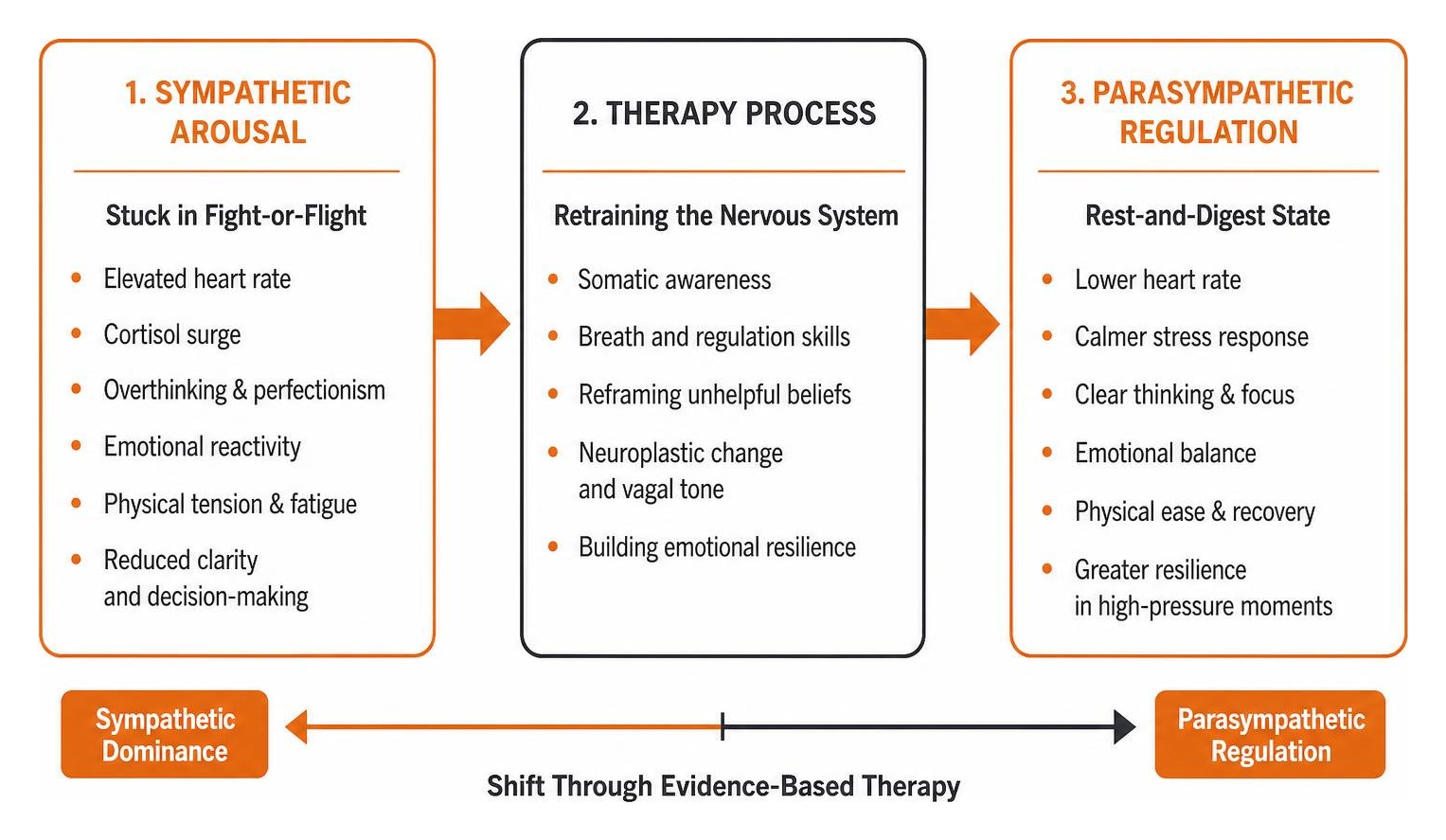
Standard talk therapy often focuses on discussing weekly stressors, but analyzing problems intellectually does not necessarily calm a dysregulated nervous system. Evidence-based care works on neuroplasticity and vagal tone, teaching the physiological body that it is safe to downshift out of survival mode and activate the parasympathetic "rest-and-digest" state. By combining somatic awareness with psychological tools, modern therapy retrains your brain and body to respond calmly during high-stakes moments.
Why Evidence-Based Anxiety Therapy for Professionals Goes Beyond Symptom Management
To create lasting resilience, specialized anxiety therapy for professionals focuses on the core drivers of nervous system dysregulation rather than just short-term coping tricks. High achievers often carry deeply ingrained beliefs that their self-worth is entirely tethered to their productivity, leading to chronic overextension and acute performance dread.
Targeted therapies dismantle these automatic loops through distinct mechanisms:
- Cognitive Behavioral Therapy (CBT): Pinpoints perfectionistic cognitive distortions (such as catastrophizing, mind reading, or all-or-nothing thinking) and restructures them into flexible, constructive assessments that support decisive leadership.
- Acceptance and Commitment Therapy (ACT): Builds psychological flexibility by helping you unhook from catastrophic thoughts, embrace necessary discomfort, clarify core professional values, and take values-aligned action under pressure.
- Performance-Focused Eye Movement Desensitization and Reprocessing (EMDR): Utilizes bilateral stimulation to reprocess past career setbacks, public embarrassments, critical evaluations, or chronic professional traumas stored within your nervous system, neutralizing somatic triggers.
Comparing Core Therapeutic Approaches for High Performers
| Modality | Core Mechanism | Target Symptoms in Professionals | Primary Expected Outcome |
|---|---|---|---|
| CBT | Cognitive restructuring and behavioral experiments | Overthinking, imposter syndrome, perfectionism | Balanced perspectives and adaptable behavioral patterns |
| ACT | Mindfulness, defusion, and values-based action | Decision avoidance, emotional reactivity, rigid control | Greater psychological flexibility and purposeful leadership |
| EMDR | Bilateral stimulation and memory reconsolidation | Performance blocks, acute trigger responses, visceral stress | Nervous system desensitization and grounded confidence |
Specialized Care: Tailoring Treatment to High-Pressure Roles
Every career path brings a distinct set of systemic pressures. A one-size-fits-all clinical approach rarely resonates with high performers who require tactical, relevant interventions tailored to their industry context and daily responsibilities.

When professional stress spills over into home life, personal relationships can suffer from emotional withdrawal, irritability, or secondary tension. In these scenarios, integrating family therapy alongside individual support helps restore balance, establish healthier boundaries across home and work domains, and build a unified support system.
Tailoring Anxiety Therapy for Professionals: Executives, Athletes, and ADHD
Different professional profiles experience anxiety through unique lenses:
- C-Suite Executives & Leaders: Struggle with isolated decision fatigue, enterprise-level accountability, and imposter fears. Therapy focuses on strategic emotional regulation, delegation without guilt, and navigating high-stakes negotiations without autonomic hyperarousal.
- Elite Athletes & Performers: Encounter acute performance anxiety and somatic panic under the spotlight. Interventions focus on performance-focused EMDR and somatic stabilization to maintain flow under pressure and overcome performance plateaus.
- Adults with ADHD: Often face executive dysfunction, internal restlessness, rejection sensitive dysphoria, and overstimulation in corporate environments. Therapy blends CBT structure with neurodivergent-affirming frameworks to build sustainable daily routines and time-management strategies.
What to Expect in Your First Session and Assessing Therapist Fit
Your initial consultation is a structured, pressure-free evaluation designed to create a practical roadmap. Your clinician will complete an intake assessment covering your workload, physiological symptoms, lifestyle factors, and past performance triggers. Reviewing frequently asked questions beforehand can help clarify how sessions run and what clinical licensure entails.
During the first session, your therapist maps out how stress impacts your nervous system and establishes measurable, collaborative milestones. You should walk away feeling heard, with a transparent understanding of the treatment plan, a strong therapeutic alliance, and practical strategies you can use immediately in your daily workflow.
Bridging In-Office Care and Daily Life: Between-Session Strategies
Therapy sessions provide the blueprint, but lasting neural adaptation happens through daily application. Practicing brief mindfulness exercises, somatic breathwork (such as the physiological sigh or box breathing), and self-compassion shifts stress responses in real time, preventing acute moments of tension from spiraling into chronic burnout.

Many professionals explore structured telehealth care packages to maintain a regular cadence of clinical care, asynchronous check-ins, and guided self-regulation exercises that fit seamlessly into their demanding workload.
Integrating Digital Tools with Therapist-Led Telehealth
Digital health interventions provide valuable scaffolding between clinical sessions. Real-time prompts, journaling prompts, and guided somatic practices reinforce skills learned in individual sessions, helping professionals ground themselves during high-stakes presentations or difficult interpersonal exchanges. Recent research demonstrates that web-based programs grounded in third-wave psychotherapy significantly reduce perceived stress and improve mental health among highly stressed healthcare workers.
A clinical trial on digital mental health interventions for healthcare professionals examining the MINDxYOU web-based program found a significant reduction in perceived stress (β = –1.08, P = .03), with even greater stress reductions among program completers (β = –1.84, P = .003). Notably, the proportion of participants categorized as experiencing "low stress" jumped from 28.8% before the intervention to 46.6% afterward. Participants engaged in formal meditation an average of 3.3 days per week (averaging 18.8 minutes per session), showing that brief digital check-ins and structured self-guided tools reinforce clinical progress. You can explore additional mental health insights on our blog.
Frequently Asked Questions About Anxiety Therapy for Professionals
How does performance-focused EMDR differ from traditional talk therapy for workplace stress?
Traditional talk therapy emphasizes verbal processing and intellectual insight. Performance-focused EMDR uses bilateral stimulation (such as side-to-side eye movements or alternating taps) to target the specific memories and physiological triggers behind workplace anxiety. This helps your nervous system reprocess past performance failures or high-pressure stress points, resolving emotional blocks without requiring endless analytical conversations.
Can virtual therapy be as effective as in-person sessions for high-functioning anxiety?
Yes. Clinical studies confirm that secure, HIPAA-compliant teletherapy is just as effective as in-person sessions for treating anxiety disorders and occupational burnout. Telehealth allows busy professionals to receive high-level clinical care directly from their private office or home, eliminating commute times and integrating easily into demanding schedules.
How are treatment outcomes measured and tracked over time?
Clinicians track tangible progress using validated clinical assessments, such as the Generalized Anxiety Disorder 7-item scale (GAD-7) and the Perceived Stress Scale (PSS). These metrics, combined with self-reported markers of resilience, sleep quality, and daily emotional regulation, ensure your therapy delivers clear, measurable improvements throughout your care.
Conclusion
Sustained professional success should not come at the cost of your health and well-being. Modern mental healthcare combines evidence-based therapies like CBT, ACT, and EMDR with flexible virtual delivery to help you build nervous system stability, maintain your drive, and recover from chronic burnout.
At All Points North Telehealth Therapy, our licensed clinicians provide outcome-tracked, personalized care designed around demanding careers. If you are ready to move past chronic workplace tension and restore sustainable performance, learn more about our specialized professional program today.